Choosing the Right Gear Motor for Robotic & Electric Lawn Mowers
Jul 28, 2026
Toosyn
_1785224569_WNo_1600d900.webp)
Selecting the wrong lawn mower drive motor can lead to wheel slippage, poor climbing ability, excessive battery consumption, overheating, and costly warranty claims. None of these show up on day one — they show up in the field, after a batch of units is already shipped.
Whether you're developing a robotic lawn mower or an electric walk-behind mower, choosing the correct gear motor determines traction, runtime, noise level, and long-term reliability. This guide explains how OEM engineers choose the right gear motor for robotic mower platforms and why many manufacturers prefer compact, high torque low RPM outdoor motor solutions built around planetary gearboxes — including where our PG32 and PG36 series fit into typical torque requirements.
What Does a Lawn Mower Drive Motor Actually Need?
_1785224409_WNo_1600d900.webp)
The right way to evaluate a lawn mower drive motor isn't by comparing generic DC motor specs — it's by checking it against the specific demands of this application.
| Requirement | Why It Matters |
| High starting torque | Grass creates heavy starting resistance, especially on wet or overgrown lawns |
| Low RPM | Better wheel traction and controlled movement on uneven terrain |
| Waterproof design | Continuous outdoor operation in dew, rain, and irrigation spray |
| Long service life | Thousands of mowing cycles across multiple seasons |
| Low noise | Residential noise regulations and night/early-morning operation |
| Compact size | Limited chassis space, especially in small robotic mower housings |
| High efficiency | Longer battery runtime per charge, a key spec for both consumers and fleet operators |
Why Planetary Gear Motors Are Preferred for Robotic Lawn Mowers
A standard gearbox can technically move a mower, but a gear motor for robotic mower applications has to do more than that — it has to do it quietly, efficiently, and reliably across thousands of cycles in an outdoor environment. This is why planetary gearboxes have become the default architecture for this application rather than spur or worm designs.
Planetary gear motors distribute load across multiple planet gears meshing simultaneously with a central sun gear, rather than through a single tooth contact path. This gives them higher torque density for a given housing diameter — important in a compact robotic mower chassis — along with a genuinely compact size, better efficiency from distributed load and lower frictional losses, smooth transmission, lower backlash for more precise, controllable movement, and a longer lifetime from spreading mechanical wear across more contact points instead of concentrating it on one.
How Much Torque Does a Lawn Mower Drive Motor Need?
This is the number procurement and engineering teams care about most, and it varies significantly by machine class.
| Mower Type | Suggested Torque |
| Small robotic mower | 10–20 kg·cm |
| Medium robotic mower | 20–40 kg·cm |
| Heavy robotic mower | 40–80 kg·cm |
| Electric lawn mower wheel drive | 60–100 kg·cm |
These figures are a starting point, not a substitute for a calculation specific to your machine. The actual torque you need is driven by wheel diameter (a larger wheel needs more torque for the same traction force), machine weight, grass resistance (thicker or wet grass increases rolling resistance substantially), climbing angle (slopes multiply the torque needed to maintain traction), and battery voltage, which interacts with gear ratio to determine both torque and speed at the wheel.
12V or 24V Gear Motor?
| 12V | 24V |
| Small mower | Commercial mower |
| Lower cost | Higher efficiency |
| Easier control electronics | Lower current draw |
| Consumer products | Professional/commercial equipment |
Most consumer robotic mowers run 12V for cost and control simplicity, while professional and commercial platforms increasingly move to 24V for the current and efficiency advantages at higher power levels. Both are standard voltage options across our PG32 and PG36 series, so this decision doesn't narrow your options — it just needs to be confirmed early against your battery system.
Brushed vs Brushless Gear Motors
| Brushed | BLDC |
| Lower cost | Longer life |
| Simple driver | Higher efficiency |
| More maintenance over time | Nearly maintenance-free |
| Entry-level mower | Premium robotic mower |
If you're developing a premium or commercial robotic mower expected to run daily for years with minimal service intervention, BLDC is generally worth the added electronics cost. If your program is cost-driven and duty cycles are moderate, a well-built brushed motor — like our PG32555 or PG36555 series — remains a genuinely reliable, cost-effective solution.
Recommended Gear Motor Solutions
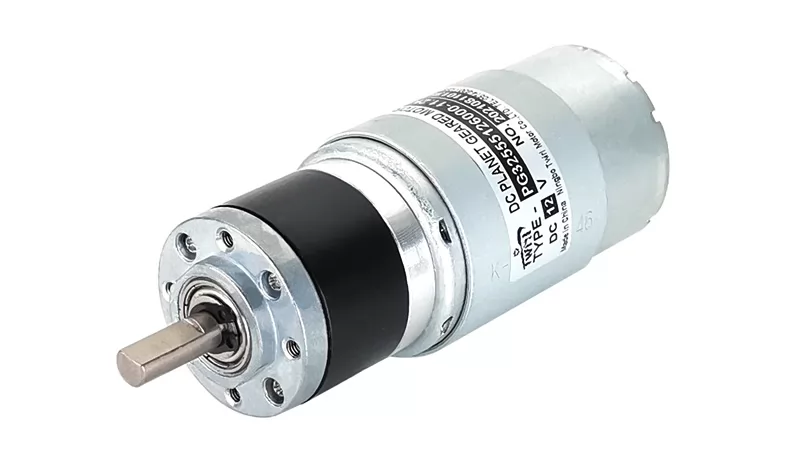 |
PG32 Series — 32mm Planetary Gear Motor
12V / 24V | 4–20W | Rated torque up to 50 kg.cm | Compact diameter, low backlash, quiet running — suited to compact and lightweight autonomous mowers
View PG32 Planetary Gear Motor specifications → |
The PG32 series is well suited to compact robotic mowers, lightweight mower chassis, and autonomous mower platforms where installation space is tight and torque requirements sit in the small-to-medium range covered above.
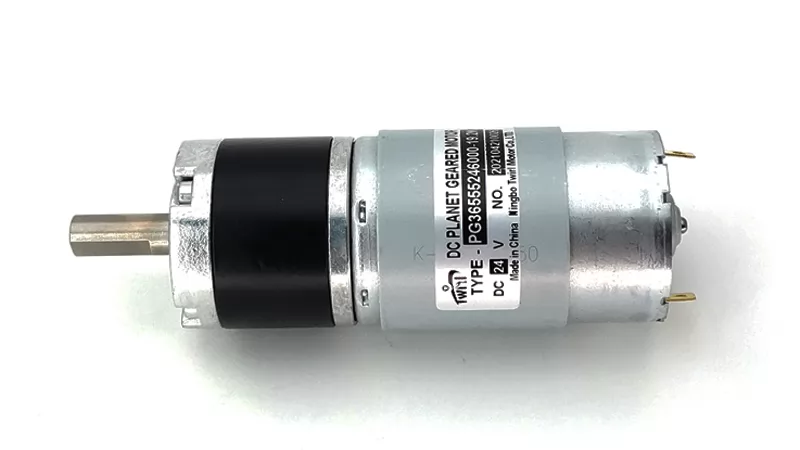 |
PG36 Series — 36mm High Torque Planetary Gear Motor
12V / 24V | 4–20W | Rated torque up to 100 kg.cm | Minimum backlash, high power density — suited to larger robotic mowers and electric wheel drive
View PG36 High Torque Gear Motor specifications → |
The PG36 series steps up to larger robotic mowers, electric wheel drive applications, and outdoor equipment that needs higher output torque, larger wheel load capacity, better climbing capability on slopes, and continuous-duty operation. For commercial-grade platforms already running BLDC drive systems, our 36mm BLDC gear motor line — built around the same case study referenced in our Lawn Mower application page (18V, 35rpm at 25 kg.cm, with an integrated driver) — is also available where brushless performance is a program requirement.
Should You Add an Encoder?
An encoder adds cost and complexity, so it's worth being specific about when it earns its place. Add one when your platform needs navigation (wheel odometry feeding into a mapping or path-planning system), differential steering (independently controlling left/right wheel speed for turning), closed-loop speed control (maintaining a set speed regardless of terrain resistance), or precise turning where dead-reckoning accuracy matters for coverage efficiency. Skip it for a simpler push mower or a basic robotic mower relying primarily on boundary wire or simple bump-and-turn navigation, where the added cost doesn't translate into a functional benefit.
Outdoor Applications Need More Than High Torque
A motor that delivers the right torque on a bench test can still fail in the field if it isn't engineered for the outdoor environment it will actually operate in. Beyond torque, an outdoor lawn mower drive motor should also provide appropriate IP protection against water and grass debris, dust resistance for dry, dusty conditions, moisture resistance for dew and irrigation exposure, corrosion protection for metal components exposed to lawn chemicals and moisture, a wide temperature operating range to cover both summer heat and cold-morning starts, and shock resistance for impacts with roots, stones, and uneven terrain. Buyers and integrators notice when a supplier addresses these details up front — it signals the motor was actually engineered for outdoor duty, not adapted from an indoor application.
Common Mistakes When Choosing a Lawn Mower Gear Motor
| Mistake 1 — Choosing torque only, ignoring efficiencyA motor that hits the torque number but runs inefficiently drains the battery faster and cuts runtime, undermining the product on a spec customers directly compare. |
| Mistake 2 — Ignoring starting currentA high inrush current at startup can cause a voltage sag across the battery, affecting other onboard electronics and shortening battery life over repeated cycles. |
| Mistake 3 — Selecting excessive RPMToo much wheel speed relative to torque leads to wheel slippage on wet grass or slopes, reducing traction exactly when it's needed most. |
| Mistake 4 — No encoder for robotic navigationSkipping encoder feedback on a platform that needs precise path coverage results in positioning errors that show up as missed patches or inefficient mowing paths. |
| Mistake 5 — Ignoring outdoor sealingUnderspecifying IP rating for a motor that will sit in wet grass and morning dew every day leads directly to higher field failure and return rates. |
Why OEM Manufacturers Choose Toosyn

Toosyn works directly with robotic mower and outdoor equipment OEMs to develop gear motor solutions rather than supplying off-the-shelf parts alone. Programs we support typically draw on:
| ✓ Custom gear ratios | ✓ Encoder integration |
| ✓ Shaft customization | ✓ Voltage customization |
| ✓ Planetary gearbox | ✓ Low noise operation |
| ✓ Stable mass production | ✓ OEM/ODM support |
| ✓ Fast prototype turnaround | ✓ IATF 16949 certified manufacturing |
Our engineering team works with mounting configurations, output shaft customization, encoder and brake accessories, EMI/RFI suppression, and application-specific seals and lubrication — the same customization process we apply across our PG32 and PG36 planetary gear motor lines — so the motor that ships is the one built for your machine, not the closest match on a shelf.
Frequently Asked Questions
What motor is used in a robotic lawn mower?
Most robotic lawn mowers use small DC gear motors — brushed or brushless — paired with a planetary gearbox at each drive wheel. A separate, typically higher-speed motor drives the cutting blade. The drive wheel motor prioritizes torque and low RPM for traction, while the blade motor prioritizes speed and cutting consistency. Voltage is matched to the mower's battery system, most often 12V or 24V, and the specific gear motor for robotic mower platforms is selected based on machine weight, wheel diameter, and expected terrain.
What RPM is best for a lawn mower drive motor?
Drive wheel RPM is generally kept low — a high torque low RPM outdoor motor is what delivers reliable traction, not a high-speed motor with a light gear ratio. The right output RPM depends on wheel diameter and target ground speed; too high an RPM for the gear ratio chosen tends to sacrifice torque and increase wheel slippage on grass.
How much torque does a robotic mower need?
As a starting reference, small robotic mowers typically need 10–20 kg.cm per wheel, medium units 20–40 kg.cm, and heavier robotic mowers 40–80 kg.cm, with electric lawn mower wheel drives sometimes requiring 60–100 kg.cm. The right figure for your machine depends on weight, wheel diameter, grass resistance, and climbing angle, and should be calculated against your specific chassis rather than assumed from a general range.
Are planetary gear motors better than spur gear motors?
For most robotic and electric mower applications, yes. Planetary gearboxes deliver higher torque density in a more compact housing, lower backlash for smoother and more controllable movement, and better efficiency from distributed gear meshing, compared with a single-stage spur gearbox of similar size. The trade-off is a modestly higher component cost, which is generally justified by the compact size and reliability gains in this application.
Is an encoder necessary?
It depends on your navigation approach. An encoder is necessary if your mower relies on wheel odometry for navigation, differential steering, closed-loop speed control, or precise turning accuracy. It's not necessary for simpler platforms using basic boundary-wire or bump-and-turn navigation, where the added cost doesn't translate into a functional improvement.
Should I choose 12V or 24V?
12V is the more common choice for consumer robotic mowers, offering lower cost and simpler control electronics. 24V suits commercial and professional-grade platforms, where higher efficiency and lower current draw matter more at higher power levels. Both voltages are standard options across our gear motor series, so the decision should be driven by your battery system and target market rather than motor availability.
Can brushed motors be used outdoors?
Yes, with appropriate sealing and design. Brushed motors remain a cost-effective, reliable solution for outdoor lawn mower applications with moderate duty cycles, particularly for entry-level and mid-range products. For premium or commercial platforms expected to run daily for years with minimal maintenance, brushless motors offer a longer service life and lower long-term maintenance burden that often justifies the added cost.
What gear ratio is best for robotic lawn mowers?
There's no single correct gear ratio — it's derived from your target wheel RPM, wheel diameter, and required torque, working backward from your motor's rated speed and torque output. This is exactly the kind of calculation our engineering team works through with OEM customers directly, since the right ratio for a compact 32mm frame will differ from what a heavier 36mm platform needs even at the same target ground speed.
|
Looking for the right gear motor for your robotic or electric lawn mower project? Toosyn offers customized PG32 and PG36 planetary gear motors with optional encoders, custom gear ratios, shafts, voltages, and OEM integration support. Share your wheel diameter, vehicle weight, voltage, and target speed, and our engineering team will recommend the optimal motor solution for your application.
|
0
Comments
Leave a Comment
Your email address will not be published. Required fields are marked *
Name can't be empty
Email error!
Message can't be empty
😍
😜
😳
😌
😄
😘
😝
😒
😃
😚
😚
😛
😟
😧
😀
😉
😓
😱
😤
😣
😂
😥
😩
😠
😢
😭
😰
😨
😡
😆
😪
😅
😐
😇
😋
😴
👿
😕
😏
😷
😵
😟
😮
😯
😑
👧
👴
😧
😬
😾
👶
👱
👵
👸
🙀
👺
👦
👩
👨
😽
😿
🙈
💩
💥
💤
😼
😹
🙉
🔥
✨
💦
👎
✌
👆
👈
💪
💹
👍
👊
💴
💶
💷
💸
👉
💵
🙏
🌎
🏧
👏
💳
👇
💑
🙆
🙅
💁
👫
👭
🙎
🙇
👑
👔
Submit Comment
Most Popular
-
 Aug 21, 2025Which Motor Is Best for Electric Vehicle? A Complete Guide for 2026
 -
 Oct 16, 2025Top 10 DC Motor Manufacturers in China 2026
 -
 Dec 18, 2025The Ultimate Buyer's Guide to High Torque DC Motors
 -
 Apr 11, 2026Top 10 China Gear Motor Manufacturer in 2026


Laster Blogs
-
 Aug 20, 2026Why Planetary Gear Motors Offer Low Backlash for Precision Positioning
 -
 Aug 19, 2026Planetary Gear Ratio Calculation: How to Calculate the Right Gear Ratio for Your Motor
 -
 Aug 18, 2026Planetary Gearbox vs Spur Gearbox: Why Planetary Wins in Compact High-Torque Applications
 -
 Aug 17, 2026What Is a Planetary DC Gear Motor and How Does It Work?


Set A Consultation Today
Name can't be empty
Email error!
Send Your Message
*We respect your confidentiality and all
information are protected.


