Gear Motor Selection Guide for Solar Tracker Systems
Jul 24, 2026
Toosyn
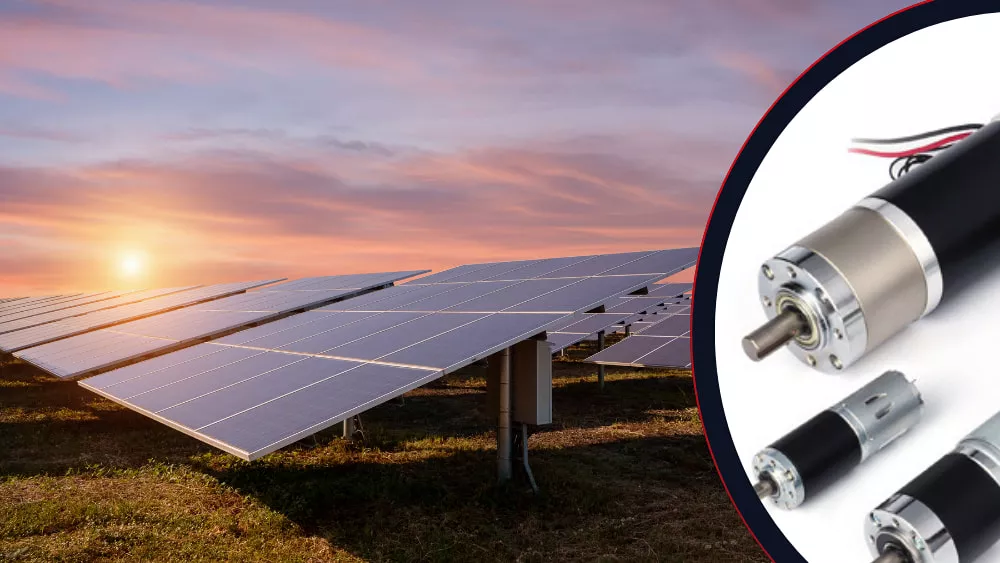
Solar trackers can increase energy yield by 15–35% compared to fixed-tilt systems, but that extra output depends entirely on one component doing its job flawlessly, year after year, in harsh outdoor conditions: the gear motor. Choose the wrong motor, and you’re looking at premature gearbox failure, tracking drift, water ingress, and costly field service calls across an entire solar farm.
This guide walks through the technical criteria that matter when specifying a gear motor for single-axis or dual-axis solar tracking systems, so engineering and procurement teams can shortlist the right motor with confidence.
Why Gear Motor Selection Is Different for Solar Trackers
Unlike indoor automation equipment, a solar tracker motor has to survive:
- Years of unattended outdoor operation — typically a 20–25 year design life to match the solar array itself
- Intermittent, low-duty-cycle movement — trackers move a few degrees every several minutes, not continuously
- High static holding loads — wind gusts push against a large panel array, and the motor/gearbox must hold position without drifting
- Temperature extremes and humidity/dust ingress — from desert heat to coastal salt air
- Precision positioning requirements — even small angular errors, repeated over thousands of cycles, reduce annual energy yield
This combination — high holding torque, low speed, precise positioning, and long-term reliability — is exactly where planetary DC gear motors outperform worm-gear or spur-gear alternatives.
Key Selection Criteria
1. Torque and Load Holding
The motor/gearbox must generate enough torque to rotate the panel array against gravity and wind load, and — just as importantly — hold that position without back-driving when the motor is off. Look for:
- Rated torque that includes a safety margin above your calculated peak wind-load torque (engineers typically size for 1.5–2x calculated load)
- Low backlash gearbox design, since backlash directly translates into tracking angle error
- A planetary gear train, which distributes load across multiple gear meshes rather than a single contact point — this is why planetary gearboxes deliver higher torque density in a smaller footprint than spur gearboxes of the same size
2. Speed and Gear Ratio
Solar trackers don’t need speed — they need controlled, slow, precise rotation. The right gear ratio matters more than raw motor RPM. A well-specified planetary gearbox lets you dial in the exact output RPM needed for your slew drive or linear actuator interface, rather than over-speccing a motor and wasting torque capacity.
3. Voltage and Power Source Compatibility
Most tracker controllers run on 12V or 24V DC, often powered directly by a small photovoltaic panel and battery, since trackers are frequently installed far from grid power. Confirm the motor’s voltage range matches your controller and battery system, and check current draw against your available power budget — this is especially important for off-grid tracker installations.
4. Positioning Accuracy — Encoder or No Encoder?
Basic timer-based trackers can run open-loop. But for trackers using closed-loop feedback control (astronomical algorithm + sensor correction), an integrated encoder is essential. An encoder-equipped planetary DC gear motor reports shaft position, speed, and direction back to the controller, enabling:
- Accurate return-to-stow positioning ahead of storms
- Correction for mechanical drift over time
- Diagnostic data on motor health for predictive maintenance across large solar farms
5. Environmental Sealing and Durability
Since the motor is typically mounted at the tracker’s pivot point, exposed to weather, verify:
- IP-rated sealing appropriate for your site conditions
- Corrosion-resistant housing materials for coastal or high-humidity installations
- A wide operating temperature range validated by the manufacturer, not just a datasheet claim
6. Compact Footprint
Tracker pivot assemblies and slew drive housings have limited space. A planetary gear motor’s coaxial, compact construction (compared to bulkier worm-gear units) simplifies mechanical integration and reduces the mounting envelope your structural engineers need to design around.
Planetary vs. Worm Gear vs. Spur Gear: Quick Comparison
| Criteria | Planetary Gear Motor | Worm Gear Motor | Spur Gear Motor |
|---|---|---|---|
| Torque density | High | Medium-High | Low-Medium |
| Backlash / positioning accuracy | Low backlash, high precision | Higher backlash | Medium backlash |
| Efficiency | High | Lower (friction losses) | Medium |
| Size for given torque | Compact | Bulkier | Larger |
| Noise & vibration | Low | Medium | Medium-High |
| Self-locking | Available with brake option | Naturally self-locking | Not self-locking |
For most modern single-axis and dual-axis tracker designs prioritizing energy yield, positioning accuracy, and long-term reliability, planetary DC gear motors are the preferred choice — particularly when combined with an encoder for closed-loop control.
A Practical Selection Checklist
Before requesting samples or quotes, gather these specs so your motor supplier can recommend the right configuration:
|
How Toosyn Supports Solar Tracker Manufacturers
Toosyn’s planetary DC gear motors are built specifically for applications that demand high torque in a compact, low-backlash package — the same requirements that define solar tracker pivot drives. Key advantages for tracker integrators:
- High torque, low backlash planetary gear trains for accurate, drift-free positioning over the tracker’s full service life
- Optional integrated encoders for closed-loop position, speed, and direction feedback
- Compact, space-saving design that fits tight slew drive and pivot housings
- Low noise and vibration, reducing mechanical stress on the tracker structure over thousands of daily cycles
- Customizable voltage (3–24V), gear ratio, and shaft configuration to match your existing controller and mechanical interface
- CE certified, ISO9001-manufactured, with OEM support for solar tracker manufacturers scaling production
Whether you’re specifying motors for a new tracker platform or looking to reduce field failures on an existing design, our engineering team can help match torque, gear ratio, and encoder specs to your exact tracker geometry and site conditions.
See how our motors perform in this exact use case on our Solar Tracker application page.
| Request a Quote or Technical Consultation → |
Looking for a custom gear ratio, voltage, or encoder configuration not listed on our standard product page? Toosyn offers OEM customization for solar tracker manufacturers — contact our engineering team to discuss your specifications.
0
Comments
Leave a Comment
Your email address will not be published. Required fields are marked *
Name can't be empty
Email error!
Message can't be empty
😍
😜
😳
😌
😄
😘
😝
😒
😃
😚
😚
😛
😟
😧
😀
😉
😓
😱
😤
😣
😂
😥
😩
😠
😢
😭
😰
😨
😡
😆
😪
😅
😐
😇
😋
😴
👿
😕
😏
😷
😵
😟
😮
😯
😑
👧
👴
😧
😬
😾
👶
👱
👵
👸
🙀
👺
👦
👩
👨
😽
😿
🙈
💩
💥
💤
😼
😹
🙉
🔥
✨
💦
👎
✌
👆
👈
💪
💹
👍
👊
💴
💶
💷
💸
👉
💵
🙏
🌎
🏧
👏
💳
👇
💑
🙆
🙅
💁
👫
👭
🙎
🙇
👑
👔
Submit Comment
Most Popular
-
 Aug 21, 2025Which Motor Is Best for Electric Vehicle? A Complete Guide for 2026
 -
 Oct 16, 2025Top 10 DC Motor Manufacturers in China 2026
 -
 Dec 18, 2025The Ultimate Buyer's Guide to High Torque DC Motors
 -
 Apr 11, 2026Top 10 China Gear Motor Manufacturer in 2026


Laster Blogs
-
 Aug 20, 2026Why Planetary Gear Motors Offer Low Backlash for Precision Positioning
 -
 Aug 19, 2026Planetary Gear Ratio Calculation: How to Calculate the Right Gear Ratio for Your Motor
 -
 Aug 18, 2026Planetary Gearbox vs Spur Gearbox: Why Planetary Wins in Compact High-Torque Applications
 -
 Aug 17, 2026What Is a Planetary DC Gear Motor and How Does It Work?


Set A Consultation Today
Name can't be empty
Email error!
Send Your Message
*We respect your confidentiality and all
information are protected.


