How to Choose a Planetary DC Gear Motor for ATM and Cash Dispenser Systems
_1786614054_WNo_1600d900.webp)
Automated Teller Machines (ATMs) and cash dispensing systems rely on a multitude of precise mechanical movements to execute financial transactions reliably. Inside these systems, operations such as cash pickup, note transport, stacker mechanism actuation, door locking, and card handling require repeatable, exact motion control. For banking equipment manufacturers, automation engineers, and purchasing managers, selecting the correct planetary DC gear motor solutions is a critical engineering decision.
In financial equipment, reliable compact actuators are not just a design preference; they are an operational necessity. These mechanisms must deliver precision movement while enduring thousands of operating cycles in varying environmental conditions. Long service life is paramount to minimize maintenance costs and machine downtime. Furthermore, compact installation is required to fit within the strict spatial constraints of modern banking modules, without compromising on torque performance. A well-engineered planetary DC gear motor provides the necessary torque density and control to meet these stringent industrial requirements.
Why ATM Machines Require High-Performance Gear Motors
ATMs differ significantly from standard automated devices. A typical commercial ATM operates 24/7, subjected to continuous public use and fluctuating environmental conditions. The internal mechanisms, particularly the cash dispenser gear motor, must execute thousands of operating cycles per week. This high duty cycle demands a motor that can maintain stable torque output over extended periods without experiencing thermal degradation or mechanical wear.
From the perspective of a motor application engineer, banking equipment requires precise motion control. The note transport system must move currency at specific velocities to ensure accurate sensor reading and stacking. Any variation in speed can result in miscounts or mechanical jams. Therefore, the motor must deliver consistent RPMs under varying load conditions.
Furthermore, noise reduction and low vibration are critical design parameters. ATMs are often installed in quiet indoor environments such as bank lobbies or retail spaces. High vibration can not only disturb the user but also prematurely wear out adjacent electronic components in the sensitive note validation module. A specialized ATM motor incorporates precision-balanced rotors and tightly toleranced gearboxes to minimize mechanical resonance, ensuring low noise operation while fitting into a compact mechanical integration footprint.
Applications of DC Gear Motors Inside ATM and Cash Dispenser Systems
The internal architecture of an ATM is a complex assembly of modular mechanisms, each relying on dedicated actuators. Understanding these applications is essential for specifying the correct motor parameters.
Cash Pickup and Dispensing Mechanism
The heart of any ATM is the cash dispensing module. This mechanism must accurately pick a specified number of banknotes from a cassette, separate them to prevent double dispensing, and transport them to the presentation slot. A cash dispenser gear motor is responsible for driving the pickup rollers, transport belts, and separation gates.
In the note pickup phase, the motor must provide high breakaway torque to overcome the static friction between the bottom note and the stack above it. Once the note enters the transport path, the motor must rapidly transition to a precise, higher speed to move the bill through the validation sensors. The torque requirements are dynamic; the motor must handle paper resistance, mechanical friction from belt tension, and the momentary load of a bill passing through curved transport ducts. Planetary DC gear motors are favored here because their concentric output shaft allows for direct coupling to roller assemblies, providing high torque amplification in a compact footprint that fits within the narrow cash handling module.
Card Reader and Door Actuation Systems
Beyond cash handling, ATMs utilize numerous auxiliary mechanisms that require reliable actuation. The motorized card reader, for instance, must smoothly ingest the user's card, hold it securely during the transaction, and return it without jamming. A banking equipment actuator is also employed in the lower security cabinet door locking mechanism, which must physically secure the cash cassettes.
These applications require bi-directional operation and precise position control. Compact gear motors are highly suitable for card handling because they provide the necessary torque to overcome insertion friction while allowing the control system to accurately monitor card position via encoder feedback. For door and locking systems, the motor must provide high holding torque and survive stall conditions without failing, ensuring physical security is never compromised.
Key Factors When Selecting a Planetary DC Gear Motor for ATM Applications
Specifying the correct motor requires a thorough engineering analysis of the mechanical and electrical requirements. The following factors must be rigorously evaluated.
1. Output Torque Requirements
Torque calculation is the foundational step in ATM motor selection. The required torque is determined by the physical characteristics of the driven mechanism. The fundamental engineering formula applied is:
Torque (T) = Load (F) × Radius (R) × Safety Factor (S)
When calculating the load, an engineer must account for paper resistance in the transport path, mechanical friction from bearings and belts, and the startup load. Startup torque is significantly higher than running torque due to static friction. For example, if a pickup roller has a radius of 10mm (0.01m) and must exert 30N of force to separate a banknote, the continuous torque requirement is 0.3 N·m. Applying a safety factor of 1.5 to account for mechanical wear and humidity-induced paper adhesion raises the requirement to 0.45 N·m. Selecting a ATM motor torque rating that exceeds this calculated value ensures reliable continuous operation under worst-case scenarios.
2. Gear Ratio and Output Speed
ATM mechanisms typically operate at relatively low speeds but require high torque. A DC motor naturally spins at high RPMs with low torque. The gearbox must convert this into the required low-speed, high-torque output. The gear ratio determines the relationship between motor input speed and gearbox output speed.
A planetary gearbox is the optimal choice for this conversion. In a planetary system, multiple gears (planets) engage simultaneously with a central sun gear and an outer ring gear. This load-sharing characteristic allows for high reduction ratios in a single, compact stage. Furthermore, the concentric alignment of the input and output shafts allows for a smoother operation and higher torque amplification compared to standard spur gear arrangements, making it ideal for the strict spatial constraints of a cash dispenser.
3. Motor Size and Installation Space
Modern ATMs are designed to maximize cash storage capacity while minimizing the overall machine footprint. This leaves very limited space for mechanical components. A compact gear motor is therefore essential. Engineers must evaluate the motor's outer diameter (OD) and overall length against the available space in the transport module.
Planetary gear motors offer superior torque density, meaning they provide higher torque per unit volume than other motor types. This allows engineers to specify a smaller motor for the same torque requirement. Additionally, compact motors often require customized mounting features, such as threaded holes on the front face or specific pilot diameters, to facilitate lightweight design and direct integration into plastic or aluminum brackets without requiring complex coupling arrangements.
4. Lifetime and Reliability
In banking automation, a mechanical failure can result in significant financial loss and customer dissatisfaction. Therefore, a long life gear motor is a strict requirement. Reliability is determined by the motor's ability to withstand continuous duty cycles. Engineers must consider the lifespan of the carbon brushes in brushed DC motors, or the bearing life in brushless designs, alongside the mechanical durability of the gearbox.
Gearbox durability is heavily influenced by the material and lubrication. Sintered steel or powder metal gears are often used in planetary configurations for their high strength and porous oil-retaining properties. When sourcing from a custom gear motor manufacturer, engineers should request detailed cycle testing data, including performance curves under maximum load to verify that the motor will not suffer catastrophic failure over the expected 500,000 to 1,000,000 dispensing cycles.
| Engineering Note An ATM cash dispensing module requires repeated forward and reverse movement with stable torque output. A common engineering mistake is selecting a motor based solely on continuous torque without calculating the peak torque required during bidirectional reversal. A planetary DC gear motor provides the necessary torque density while maintaining compact installation dimensions, absorbing the shock loads generated during sudden direction changes without gear tooth failure. |
Planetary Gear Motor vs Standard DC Motor for ATM Applications
When designing a banking mechanism, engineers must choose between a standard DC motor (potentially with an external spur gearbox) and an integrated planetary DC gear motor. The comparison below highlights why planetary solutions are predominantly chosen for critical banking functions.
| Feature | Standard DC Motor | Planetary DC Gear Motor |
|---|---|---|
| Torque | Low; requires external amplification | High; in-line gear amplification |
| Speed control | Difficult at low RPMs | Better; stable low-speed output |
| Size | Larger system required (motor + separate gearbox) | Compact; integrated co-axial design |
| Efficiency | Lower due to multiple mechanical joints | High; up to 90% per stage due to parallel load sharing |
| Reliability | Prone to backlash and shaft misalignment | High; robust bearing support and even gear wear |
| Integration difficulty | Complex; requires coupling design | Simple; single unit, direct mounting |
| Application | Simple rotation, fans, basic pumps | Precision mechanisms, cash handling, robotics |
Recommended Planetary DC Gear Motor Series for ATM Systems
Selecting the right motor series is critical for balancing performance, space, and cost. Toosyn offers specialized DC planetary gear motor series engineered for the rigorous demands of banking automation. Below are two highly recommended series for ATM and cash dispenser applications.
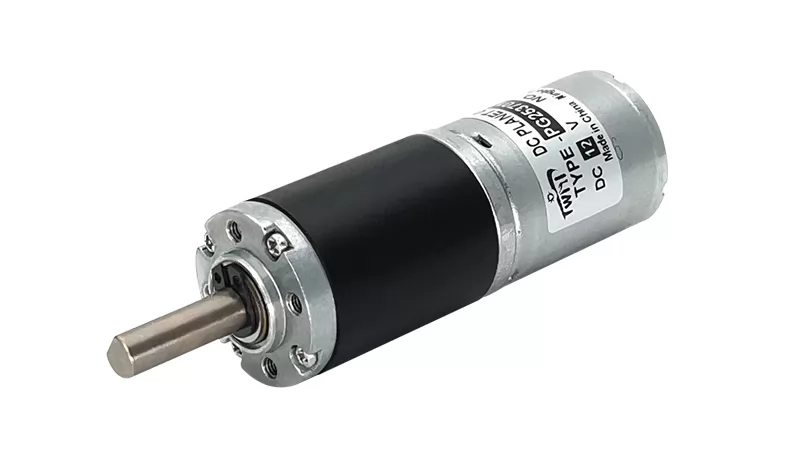 |
Toosyn PG25370 Series
Target Application: Compact banking equipment, cash dispenser transport modules, card handling mechanisms. Key Features:
|
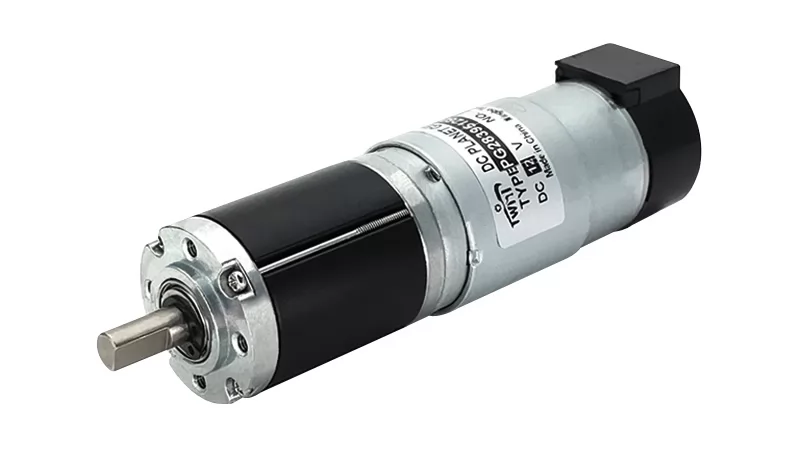 |
Target Application: Heavy-duty dispensing mechanisms, ATM cassette pickup, stacker mechanisms, and secure door actuators. Key Features:
|
How To Select the Right Gear Motor for ATM Equipment
To ensure optimal performance and longevity, engineers should follow a systematic selection guide when specifying a gear motor for ATM equipment.
- Step 1: Define Mechanism Load Analyze the physical transport path. Calculate the maximum weight of the banknotes, the friction coefficient of the transport belts, and the resistance of the pickup rollers. Determine if the motion is unidirectional or requires frequent reversing.
- Step 2: Calculate Torque Use the formula (Load × Radius) to find continuous torque, and apply a safety factor of 1.5 to 2.0 to determine the required peak startup torque. Ensure the selected motor's rated torque exceeds the continuous requirement.
- Step 3: Select Gear Ratio Determine the required linear speed of the transport belt. Calculate the necessary RPM at the roller. Divide the motor's base speed by the required roller speed to find the necessary gear ratio. Ensure the gearbox can handle the calculated output torque.
- Step 4: Check Motor Dimensions Map out the physical envelope of the cash dispensing module. Verify the motor diameter and length. Ensure there is adequate clearance for ventilation and that the mounting points align with the bracket design.
- Step 5: Verify Lifetime Requirements Cross-reference the motor's duty cycle rating with the ATM's expected transaction volume. Request L10 bearing life data and brush wear curves from the manufacturer to ensure the motor will survive the required operational cycles without maintenance.
- Step 6: Customization Considerations Evaluate if standard off-the-shelf models meet the electrical (voltage, current) and mechanical (shaft, flange) requirements. If not, specify the necessary customizations, such as custom winding for specific voltage rails or integrated encoders for closed-loop speed control.
Why Choose Toosyn for Banking Equipment Gear Motor Solutions
As a specialized manufacturer, Toosyn provides high-quality planetary gear motor solutions tailored for the stringent demands of banking automation. Our engineering approach is grounded in technical expertise and strict quality control, adhering to Google E-E-A-T principles by delivering verifiable, experience-based manufacturing capabilities.
|
Engineering Support Our team of application engineers assists banking equipment manufacturers in calculating torque requirements, optimizing gear ratios, and validating motor performance for specific ATM architectures. |
Customization Ability We offer comprehensive customization, including specific voltage windings, custom gear ratios, specialized output shafts (D-cut, double-flatted, pinion), and integrated encoders for precise motion control. |
|
Application Experience Toosyn has extensive experience in financial automation, understanding the unique requirements for noise reduction, high cycle durability, and compact integration within cash handling modules. |
Manufacturing Capability With advanced production facilities and rigorous quality testing protocols, including 100% torque and noise testing, we ensure consistent, high-volume supply of reliable actuators for global OEMs. |
Frequently Asked Questions (FAQ)
What motor is commonly used in ATM cash dispenser systems?
DC gear motors and planetary gear motors are commonly used because they provide a compact size and high torque output. The planetary gearbox allows for efficient speed reduction and torque amplification within the tight spatial constraints of a cash dispensing module, ensuring accurate and reliable banknote transport.
Why are planetary gear motors suitable for banking equipment?
Because they provide high torque density, smooth operation, and reliable performance in limited installation spaces. The co-axial design of planetary gears allows for direct integration into roller assemblies, reducing mechanical complexity and improving the lifespan of the banking equipment actuator.
Can ATM gear motors be customized?
Yes. Manufacturers can customize voltage, gear ratio, shaft design, mounting dimensions, and electrical specifications. Customization is frequently required to match the specific spatial constraints and speed/torque profiles of different ATM mechanisms, such as note pickup versus card transport.
What factors affect ATM motor selection?
The primary factors include required output torque, output speed, duty cycle, installation space constraints, noise requirements, and lifetime expectations. Engineers must also consider the mechanical integration, such as the mounting flange and shaft type, to ensure seamless incorporation into the ATM module.
|
Looking for a reliable planetary DC gear motor for ATM, cash dispenser, or banking automation equipment? Share your torque requirements, operating voltage, installation space, duty cycle, and actuator specifications — Toosyn’s engineering team will recommend the most suitable gear motor solution for your financial equipment application.
Email: sales@toosyn.com
Phone: +86-574-8301 1768 Partner with Toosyn for high-torque, low-noise, and precision planetary DC gear motors engineered for ATM mechanisms, cash dispensers, and banking automation systems. |
Written by Toosyn Engineering Team. Specialized in DC gear motor and planetary gearbox solutions for automation equipment.
0
Comments
Leave a Comment
Your email address will not be published. Required fields are marked *
Name can't be empty
Email error!
Message can't be empty
😍
😜
😳
😌
😄
😘
😝
😒
😃
😚
😚
😛
😟
😧
😀
😉
😓
😱
😤
😣
😂
😥
😩
😠
😢
😭
😰
😨
😡
😆
😪
😅
😐
😇
😋
😴
👿
😕
😏
😷
😵
😟
😮
😯
😑
👧
👴
😧
😬
😾
👶
👱
👵
👸
🙀
👺
👦
👩
👨
😽
😿
🙈
💩
💥
💤
😼
😹
🙉
🔥
✨
💦
👎
✌
👆
👈
💪
💹
👍
👊
💴
💶
💷
💸
👉
💵
🙏
🌎
🏧
👏
💳
👇
💑
🙆
🙅
💁
👫
👭
🙎
🙇
👑
👔
Submit Comment
Most Popular
-
 Aug 21, 2025Which Motor Is Best for Electric Vehicle? A Complete Guide for 2026
 -
 Oct 16, 2025Top 10 DC Motor Manufacturers in China 2026
 -
 Dec 18, 2025The Ultimate Buyer's Guide to High Torque DC Motors
 -
 Apr 11, 2026Top 10 China Gear Motor Manufacturer in 2026


Laster Blogs
-
 Aug 20, 2026Why Planetary Gear Motors Offer Low Backlash for Precision Positioning
 -
 Aug 19, 2026Planetary Gear Ratio Calculation: How to Calculate the Right Gear Ratio for Your Motor
 -
 Aug 18, 2026Planetary Gearbox vs Spur Gearbox: Why Planetary Wins in Compact High-Torque Applications
 -
 Aug 17, 2026What Is a Planetary DC Gear Motor and How Does It Work?


Set A Consultation Today
Name can't be empty
Email error!
Send Your Message
*We respect your confidentiality and all
information are protected.


