How to Choose a Planetary Gear Motor for Drone Landing Gear and Payload Release Systems
Aug 13, 2026
Toosyn
_1786609540_WNo_1600d900.webp)
Selecting the right actuator for drone landing gear and payload release mechanisms is one of the most consequential decisions a UAV engineer faces during the design phase. Unlike ground-based industrial systems where weight and envelope constraints are moderate, every gram and every cubic millimeter matters in unmanned aerial vehicles. A motor that delivers insufficient torque leads to deployment failure under load, while an oversized actuator steals precious payload capacity and reduces flight endurance. The challenge is finding a planetary gear motor that provides high output torque in the smallest possible form factor, operates reliably across temperature extremes and vibration profiles, and integrates cleanly into the airframe structure without requiring excessive modification.
Planetary gear motors have become the actuator of choice for an increasing number of UAV subsystems because their multi-stage epicyclic gear train delivers superior torque density compared to spur-gear or worm-gear alternatives. The coaxial arrangement of input shaft, output shaft, and gearbox housing simplifies mechanical integration, allowing engineers to mount the actuator inline with landing-gear struts, payload bay doors, or release linkage arms. When combined with a brushless DC motor core, a planetary gearbox produces a compact, efficient drive unit that can be precisely controlled by the flight controller via PWM or CAN bus signals.
This guide is written for UAV systems engineers, drone OEM designers, and robotics integrators who need to specify, evaluate, and source planetary gear motor solutions for landing-gear and payload-release applications. We will walk through the critical selection parameters—torque, weight, speed, backlash, duty cycle, and customization—with calculation methods, comparison data, and application examples drawn from real-world UAV platforms. The goal is to give you a repeatable engineering framework, not just a list of product recommendations.
Why Drone Applications Require Specialized Gear Motors
Unmanned aerial vehicles operate under a set of constraints that make off-the-shelf industrial gear motors unsuitable for most flight-critical actuation tasks. The five primary factors that distinguish UAV actuator requirements from general-purpose motion control are payload capacity limits, restricted installation envelopes, battery energy budget, vibration and shock exposure, and the need for repeatable positioning accuracy. Each of these factors directly influences the specification of a drone actuator motor or UAV gear motor.
Weight sensitivity. A typical small-to-medium UAV carries a useful payload of 2 to 15 kg. Every actuator added to the airframe draws from this budget. If the landing-gear mechanism requires two gear motors and each weighs 250 g instead of the target 150 g, the aircraft loses 200 g of payload capacity—a significant penalty for commercial or mapping drones where every sensor gram translates to flight time or data quality. Engineers therefore seek actuators with the highest possible torque-to-weight ratio, which is precisely what a planetary gear motor with a high-reduction-ratio stage provides.
Torque density. In a UAV landing-gear system, the actuator must overcome the weight of the strut assembly, aerodynamic drag during deployment, and any friction in the hinge bearings—all while operating from a low-voltage battery source (typically 11.1 V to 22.2 V for LiPo or Li-ion packs). Achieving output torque in the range of 1–10 Nm from a 12 V DC supply demands a gear reduction system that multiplies motor torque efficiently. Planetary gearboxes achieve this through multiple meshing planet gears that share the load, resulting in higher torque capacity per unit volume than single-stage spur gearboxes.
Installation space. The airframe structure of a drone leaves narrow channels for actuators, wiring, and linkages. A compact gear motor with a coaxial output shaft allows the actuator to sit inside a hollow strut tube or behind a fuselage bulkhead without requiring bell-crank conversions or right-angle drives that introduce backlash and points of failure. This compact gearbox design is a fundamental advantage of planetary gear architecture over parallel-shaft or worm-drive alternatives.
Vibration resistance. Drone rotors, propulsion systems, and turbulent airflow subject the airframe to continuous vibration, often in the 20–500 Hz range depending on platform type. Gear motors used in landing gear or payload release mechanisms must maintain reliable operation under these conditions without gear tooth fatigue, bearing wear, or connector loosening. Planetary gearboxes, with their distributed load paths and multiple simultaneous tooth engagements, inherently damp vibration better than gear systems with single-point contact.
Power efficiency. Because every watt-hour of battery energy determines flight endurance, actuator efficiency directly affects mission duration. Brushless DC planetary gear motor combinations with efficiencies of 70–85% are strongly preferred over hydraulic or pneumatic systems that suffer from leakage losses and compressibility inefficiencies. The electrical-to-mechanical conversion path of a DC motor coupled with a planetary gearbox is the most energy-efficient actuation method available for small and medium UAV platforms.
Key Factors When Selecting a Planetary Gear Motor for UAV Applications
Choosing the correct planetary gear motor for a specific drone mechanism requires a systematic evaluation of seven interdependent parameters. Below, we examine the four most critical factors—torque, weight and size, speed, and backlash—with calculation guidance and engineering context for each.
1. Torque Requirement
Torque is the single most important specification for any UAV actuator because it determines whether the mechanism can overcome resistance forces under real operating conditions. For a drone landing gear or payload release system, the required output torque depends on the mechanical load, the lever arm geometry, friction losses, and a safety margin. Engineers calculate the minimum required torque using the following formula:
Torque (Nm) = Force (N) × Lever Arm (m)
For a retractable landing-gear strut, the force component includes the weight of the strut assembly (mass × gravity), the aerodynamic drag force on the strut during deployment, and the friction in the hinge mechanism. The lever arm is the perpendicular distance from the hinge axis to the point where the actuator applies force. For a payload release mechanism, the force is typically the preload force on a latch or hook, and the lever arm is the radius of the release cam or lever.
In practice, engineers apply a safety factor of 1.5–2.0 to the calculated torque to account for transient loads, manufacturing tolerances, battery voltage drop under load, and degradation over the motor’s service life. For example, if the calculated deployment torque for a landing-gear strut is 2.5 Nm, specifying a motor rated for 4.0–5.0 Nm provides adequate headroom without significant weight penalty.
Two additional torque specifications deserve attention: startup torque (also called stall torque or breakaway torque), which is the peak torque required to initiate motion from a stationary position, and holding torque, which is the torque the actuator must maintain to keep the mechanism in a locked position without backdriving. For landing-gear systems, holding torque is particularly important because the gear must remain firmly in the deployed or retracted position throughout the flight, including during maneuvers that generate inertial loads on the strut.
| Application | Typical Torque Range (Nm) | Key Consideration |
|---|---|---|
| Small UAV landing gear (<5 kg) | 0.5 – 2.0 | Compact envelope, low weight |
| Medium UAV landing gear (5–25 kg) | 2.0 – 8.0 | Higher safety factor, wind resistance |
| Payload release mechanism | 0.5 – 3.0 | Fast response, reliable latch engagement |
| Camera gimbal / pan-tilt | 0.1 – 1.5 | Smooth motion, low backlash |
| Drone gripper / robotic arm | 1.0 – 6.0 | Variable torque, precise gripping force |
Technical Example: A compact UAV landing gear system requires 3 Nm torque with limited installation space. A planetary gearbox with a 50:1 reduction ratio paired with a 12 V BLDC motor producing 0.08 Nm at the input shaft delivers approximately 4 Nm at the output (accounting for 85% gearbox efficiency), providing a 33% safety margin while maintaining a total actuator weight under 120 g.
2. Weight and Size Optimization
In UAV design, actuator weight and physical dimensions are as important as torque output. A gear motor that meets the torque requirement but exceeds the weight budget or does not fit within the allocated envelope is not a viable solution. Planetary gear motors excel in both dimensions because the epicyclic gear arrangement packs multiple reduction stages into a short axial length while distributing torque loads across three or more planet gears.
The torque density of a planetary gearbox—typically expressed as output torque per unit mass or per unit volume—is 30–50% higher than an equivalent spur-gear or worm-gear unit. This advantage comes from the concurrent meshing of multiple planet gears, which allows each individual gear tooth to carry less force for the same total torque throughput. The result is a lighter gearbox housing, smaller gear teeth, and shorter overall length, all of which translate directly into weight savings on the airframe.
Coaxial output alignment is another key advantage. In a planetary gear motor, the output shaft is collinear with the input shaft, meaning the actuator occupies a single cylindrical volume. This contrasts with parallel-shaft gearboxes, where the input and output are offset, requiring additional mounting hardware and consuming more installation space. For UAV mechanisms where actuators must fit inside structural tubes, fuselage fairings, or behind access panels, the coaxial design of a planetary gear motor significantly simplifies mechanical layout.
| Feature | Planetary Gearbox | Spur Gearbox | Worm Gearbox |
|---|---|---|---|
| Torque density | High | Medium | Medium |
| Axial length (per stage) | Short | Long | Long |
| Coaxial input/output | Yes | No | No (90° offset) |
| Efficiency | 85–95% | 90–97% | 50–80% |
| Self-locking | No | No | Yes |
| Weight (comparable output) | Low | High | High |
For engineers designing lightweight drone actuators, the selection process typically begins with a target output torque and a maximum allowable diameter. From these two constraints, the required gear ratio and minimum motor size can be derived. A custom planetary gear motor manufacturer can then propose configurations that optimize the trade-off between torque, weight, and diameter for the specific installation space.
3. Speed Requirements
The speed at which the output shaft rotates—or more practically, the time it takes for the mechanism to complete its stroke—varies significantly across drone actuator applications. Understanding the speed requirement is essential because it determines the motor’s RPM specification and the gearbox ratio. A higher gear ratio increases torque but reduces output speed, while a lower ratio does the opposite. The engineer’s task is to find the balance point where both torque and speed meet the mechanism’s operational requirements.
Landing gear deployment typically requires low speed and high torque. The actuator must push or pull the strut assembly through its full range of motion (usually 60–120 degrees of rotation or 50–150 mm of linear travel) within 2–5 seconds. Speed is not the primary concern; rather, the actuator must deliver sustained torque throughout the deployment stroke, including the moment of maximum mechanical advantage where the strut linkage geometry creates the highest load on the motor.
Payload release mechanisms demand fast response. In delivery drones, search-and-rescue UAVs, and agricultural systems, the release event must occur within a fraction of a second to ensure accurate payload placement. Typical release times range from 100 to 500 milliseconds, requiring a high-speed output shaft or a mechanism with low inertia. In this case, a lower gear ratio (and thus lower torque multiplication) is acceptable because the latch mechanism requires relatively low force to trigger, but the speed of actuation must be reliable and repeatable.
Camera gimbals and sensor positioning mechanisms prioritize smooth, precise motion over raw speed. The planetary gear motor must provide consistent angular velocity with minimal speed fluctuation, which requires low backlash and smooth gear tooth profiles. Output speeds for gimbal applications typically range from 10–100 RPM depending on the camera size and stabilization requirements.
| Application | Typical Output Speed | Speed Priority | Torque Priority |
|---|---|---|---|
| Landing gear deployment | 30–120 RPM | Low | High |
| Payload release | 200–600 RPM | High | Medium |
| Camera gimbal / pan-tilt | 10–100 RPM | Medium (smooth) | Medium |
| Drone gripper | 40–200 RPM | Medium | High |
When specifying speed, engineers should also consider the duty cycle—the ratio of active actuation time to rest time over a given period. Landing gear motors typically operate in short bursts (a few seconds per deployment cycle) and can be rated for intermittent duty, while continuous-rotation applications such as camera gimbals may require continuous-duty motors with adequate thermal dissipation.
4. Backlash and Position Accuracy
Backlash—the rotational play between mating gear teeth when the direction of rotation reverses—is a critical specification for UAV mechanisms that require precise positioning. In landing gear systems, excessive backlash can cause the strut to overshoot its deployed position or fail to lock securely, creating a safety risk during takeoff and landing. In payload release mechanisms, backlash in the drive train can delay the release command by a few milliseconds, which may affect payload placement accuracy at high altitude or high speed.
Planetary gearboxes generally exhibit lower backlash than worm gears (which often have 1–3 degrees of backlash) and comparable or slightly lower backlash than precision spur gearboxes. The actual backlash value depends on the gear quality grade (ISO 6, 7, or 8), the number of reduction stages, and whether the gearbox uses helical or straight-cut planet gears. Helical planetary gearboxes offer smoother engagement and lower backlash at the cost of slightly higher axial thrust, which must be managed by thrust bearings in the output stage.
For UAV landing gear that uses position feedback (such as Hall-effect sensors or potentiometers on the output shaft), a backlash of less than 0.5 degrees is generally sufficient to achieve repeatable positioning within the required tolerance. For payload release mechanisms that do not rely on position feedback but instead use limit switches to detect the open/closed state, backlash is less critical for positioning but still affects the response time and repeatability of the release event.
| Backlash Specification | Typical Value | Suitable Application |
|---|---|---|
| Standard | 0.5° – 1.5° | General-purpose landing gear, release actuators |
| Low backlash | 0.2° – 0.5° | Precision gimbals, position-critical mechanisms |
| Ultra-low backlash | < 0.2° | High-precision camera stabilization, surveying |
Engineers should specify the maximum acceptable backlash when requesting quotations from gear motor suppliers, as tighter backlash requirements increase manufacturing cost and may extend lead times. The key is to match the backlash specification to the functional requirement of the mechanism without over-specifying.
Planetary Gear Motor vs Servo Motor for Drone Mechanisms
When UAV designers evaluate actuator options, the comparison between planetary gear motors and servo motors is one of the most common and consequential decisions. Both technologies can drive landing gear, payload release, and other drone mechanisms, but they differ significantly in torque density, customization flexibility, control architecture, and integration complexity. The following comparison is intended to help engineers make an informed choice based on the specific requirements of their application.
| Feature | Servo Motor | Planetary Gear Motor |
|---|---|---|
| Torque density | Medium | High |
| Size (for comparable output) | Medium to large | Compact |
| Weight (for comparable output) | Heavier | Lighter |
| Customization level | Limited (sealed unit) | High (voltage, ratio, shaft, housing) |
| Built-in feedback | Yes (potentiometer or encoder) | Optional (add external sensor) |
| Control interface | PWM signal (1–2 ms) | Direct motor drive (PWM, CAN, analog) |
| Industrial integration | Medium | Excellent (modular design) |
| Duty cycle capability | Low to medium (thermal limits) | Medium to high (depends on motor core) |
| Cost (per unit, comparable torque) | Higher | Lower (for OEM volumes) |
| Backlash control | Factory-set | Specifiable at design stage |
Landing gear. For retractable landing gear that requires high torque and must fit within a tight structural envelope, planetary gear motors are generally the better choice. Their higher torque density allows engineers to use a smaller, lighter actuator that delivers the required deployment force. Servo motors, while convenient due to their built-in position feedback, typically require a larger frame size to achieve the same output torque, adding unnecessary weight to the airframe. However, for very small drones (under 2 kg) where the torque requirement is modest and simplicity of integration is paramount, a high-torque hobby servo may be a practical and cost-effective solution.
Payload release. Payload release mechanisms benefit from the fast response time and precise control of servo motors in some configurations, particularly when the release is triggered by a simple position command. However, for systems that require higher force or where the release mechanism has a high preload (such as a spring-loaded latch), a planetary gear motor paired with an external limit switch provides more reliable actuation under load. The customizable output shaft of a planetary gear motor also allows direct integration with the release linkage without additional coupling hardware.
Drone robotic arms and grippers. Multi-degree-of-freedom robotic arms mounted on drones present a trade-off between servo motors (which offer built-in closed-loop positioning) and planetary gear motors (which offer higher torque and greater design flexibility). In practice, many high-performance drone grippers use a hybrid approach: a planetary gear motor for the primary gripping joint (where high torque and compact size are essential) and a servo motor for secondary positioning axes (where built-in feedback simplifies control logic). The decision ultimately depends on the torque requirement, the number of axes, the available control architecture, and the weight budget.
| Common Mistake Selecting a servo motor based solely on its torque rating without verifying its physical dimensions and weight. Many servo motors rated for high torque use large housings that cannot be accommodated within the airframe structure of a small or medium UAV. Always confirm the actuator’s envelope dimensions before committing to a design. |
Applications of Planetary Gear Motors in UAV Systems
Planetary gear motors are used across a growing range of UAV subsystems, from primary flight mechanisms to mission-specific payload handling. Below, we examine three of the most common applications in detail, explaining the mechanical role of the gear motor in each system and the key specifications that drive component selection.
Retractable Landing Gear
Retractable landing gear systems are found on fixed-wing UAVs, hybrid VTOL platforms, and some multirotor drones that require clean aerodynamics during cruise flight. The planetary gear motor drives the deployment and retraction mechanism, which typically uses a rotary actuator to swing the strut assembly between the stowed and deployed positions. In some designs, the gear motor drives a lead screw that converts rotary motion to linear travel, pushing a latch mechanism to lock the strut in position.
The key requirements for a landing gear actuator include sufficient torque to overcome strut weight, hinge friction, and aerodynamic drag during deployment; a self-locking or brake mechanism to hold the strut in the deployed position without continuous power draw; and compact dimensions that allow the motor to be housed within or adjacent to the fuselage structure. A drone landing gear actuator based on a planetary gear motor with a 60–100:1 reduction ratio and a rated output torque of 2–6 Nm is typical for platforms in the 5–25 kg weight class.
Payload Release Mechanism
Payload release mechanisms are critical components of delivery drones, agricultural spraying UAVs, search-and-rescue systems, and scientific instrument deployment platforms. The planetary gear motor drives a latch, hook, or bay-door mechanism that must open and close reliably under flight conditions. In delivery applications, the release mechanism must activate within a precise time window to ensure the payload lands at the target coordinates, making response speed and repeatability essential.
A payload release mechanism motor typically requires moderate torque (the latch force is often 10–50 N, converted to torque through the mechanism geometry), fast actuation time (100–500 ms for the full stroke), and the ability to operate reliably after long periods of inactivity (the release mechanism may remain closed for the entire flight duration before a single activation event). Engineers often specify a planetary gear motor with a lower gear ratio for release mechanisms to prioritize speed over torque, and may include a return spring to bias the latch toward the closed position for fail-safe operation.
Drone Gripper
Drone grippers and lightweight robotic arms are increasingly used for applications such as infrastructure inspection, sample collection, package retrieval, and agricultural harvesting. The planetary gear motor drives the gripper’s jaw-closing mechanism or the arm’s joint rotation, providing the torque needed to grasp and hold objects of varying weight and geometry. Unlike landing gear or payload release systems, gripper applications often require variable torque control—the motor must close the jaws with enough force to grip the object without crushing it.
For a typical drone gripper handling payloads of 0.5–5 kg, a planetary gear motor with 1–4 Nm output torque, 40–150 RPM output speed, and a compact form factor (22–37 mm diameter) is appropriate. The ability to customize the output shaft (e.g., with a spline, D-cut, or threaded interface) simplifies integration with the gripper’s jaw linkage. Some advanced gripper designs use two planetary gear motors per joint—one for driving the motion and one for braking—to achieve precise torque control without relying on complex electronic current limiting.
How To Select the Right Planetary Gear Motor Model
Selecting the right planetary gear motor for a UAV application is a structured engineering process that begins with defining the mechanical requirements and ends with verifying the candidate motor’s performance against the full operating profile. The following step-by-step guide provides a repeatable methodology that UAV engineers can apply to any actuator selection task.
Step 1: Define the torque requirement. Calculate the maximum torque the mechanism demands under worst-case conditions (maximum payload, maximum aerodynamic load, low battery voltage). Use the formula Torque = Force × Distance and apply a safety factor of 1.5–2.0. Also determine the holding torque or stall torque requirement for applications where the motor must maintain position against an external load.
Step 2: Define the speed requirement. Determine the required output speed or stroke time for the mechanism. Calculate the output RPM from the stroke distance and the required actuation time. Cross-check that the speed is compatible with the torque requirement at the selected gear ratio—remember that increasing the gear ratio increases torque but decreases speed proportionally.
Step 3: Calculate the gearbox ratio. Once you know the motor’s no-load speed (from its Kv rating or RPM specification at the operating voltage) and the required output speed, the gear ratio is: Gear Ratio = Motor Speed / Required Output Speed. Verify that the output torque at this ratio (Motor Torque × Gear Ratio × Efficiency) meets or exceeds the calculated requirement.
Step 4: Check voltage compatibility. Confirm that the motor’s rated voltage matches the UAV’s battery bus voltage or the output of the electronic speed controller (ESC). Most UAV actuators operate on 12 V (3S LiPo), 22.2 V (6S LiPo), or 24 V DC. Operating a motor below its rated voltage reduces output torque and speed; operating above it risks overheating and insulation failure.
Step 5: Verify mechanical dimensions. Confirm that the motor’s diameter, length, output shaft configuration, and mounting interface fit within the allocated space on the airframe. Pay particular attention to the output shaft type (round, D-cut, threaded, or custom spline) and the location of cable exits and connectors, which must align with the airframe’s cable routing channels.
Step 6: Evaluate duty cycle and thermal performance. Estimate the actuator’s duty cycle based on the mission profile. For intermittent-duty applications (landing gear, payload release), most planetary gear motors are adequately rated. For continuous-duty applications (camera gimbals, continuously rotating sensors), verify that the motor’s thermal dissipation is sufficient for the expected ambient temperature range.
| Common Mistake Specifying a gear motor based on its rated torque without verifying performance at the actual operating voltage. A motor rated for 5 Nm at 24 V may deliver only 2.5 Nm at 12 V. Always calculate the expected output at the drone’s actual battery voltage, not the motor’s maximum rated voltage. |
Recommended Planetary Gear Motor Series for Drone Applications
The following series represents Toosyn’s lightweight planetary gear motor platform, designed specifically for applications where compact dimensions, low weight, and reliable torque output are primary selection criteria. Each series is available in multiple gear ratio configurations and can be customized for voltage, shaft geometry, and mounting interface to match specific UAV integration requirements.
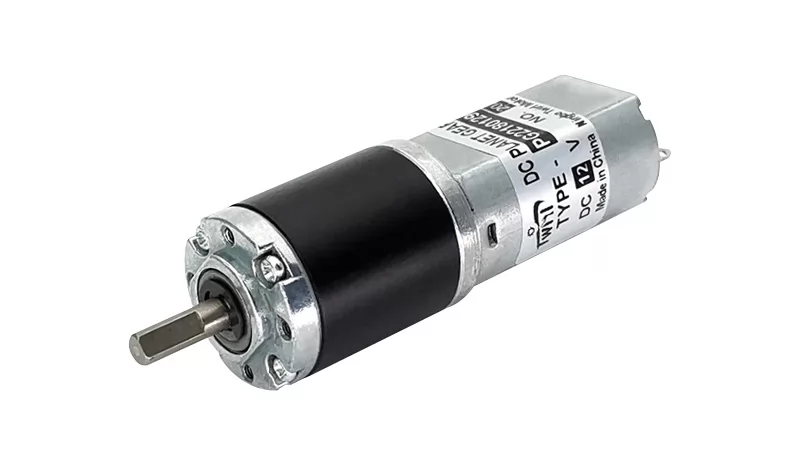 |
A compact, high-torque-density planetary gear motor family designed for small and medium UAV platforms. Available in three frame sizes with customizable gear ratios from 4:1 to 1000:1, this series provides the torque output, speed range, and dimensional flexibility required for landing gear, payload release, gripper, and gimbal actuator applications.
|
| Parameter | 22 mm Series | 28 mm Series | 37 mm Series |
|---|---|---|---|
| Diameter | 22 mm | 28 mm | 37 mm |
| Length (motor + GB) | 45 – 70 mm | 55 – 85 mm | 65 – 110 mm |
| Rated torque | 0.3 – 1.5 Nm | 0.8 – 4.0 Nm | 2.0 – 8.0 Nm |
| Weight | 35 – 65 g | 65 – 110 g | 110 – 180 g |
| No-load speed (at rated V) | 10 – 800 RPM | 8 – 600 RPM | 5 – 500 RPM |
| Voltage | 6 V / 12 V | 12 V / 24 V | 12 V / 24 V |
For UAV engineers who need a lightweight planetary gear motor that can be tailored to a specific mechanism, Toosyn offers a customization service that adjusts winding parameters, gear ratio, output shaft geometry, cable length, and connector type to match the exact requirements of the landing gear, payload release, or gripper design. This approach reduces integration effort and eliminates the need for aftermarket adapters or modifications.
Why Choose Toosyn as Your UAV Gear Motor Supplier
Selecting a planetary gear motor supplier for UAV applications goes beyond comparing datasheets. The ability to customize motor parameters, the quality of engineering support during the integration phase, and the consistency of manufacturing quality across production batches all affect the success of the final product. Toosyn’s position as a planetary gear motor manufacturer with direct control over motor winding, gearbox assembly, and quality testing provides UAV OEMs with several practical advantages.
| Engineering Support | Toosyn’s engineering team works with UAV designers during the actuator selection phase, providing torque calculations, gear ratio recommendations, and thermal analysis to ensure the chosen motor configuration meets the mechanism’s requirements under all operating conditions. |
| Customization Capability | Voltage, winding configuration, gear ratio, output shaft type, cable length, connector specification, and housing dimensions can all be modified to match the UAV platform’s electrical and mechanical interfaces. Customization reduces design iteration time and eliminates workaround hardware. |
| Production Experience | With established manufacturing lines for DC gear motors and planetary gearboxes, Toosyn supports both prototyping volumes (10–100 units) and production-scale orders (1,000+ units) with consistent quality and documented process control. |
| Quality Control | Every motor assembly undergoes torque testing, noise measurement, and electrical parameter verification before shipment. Incoming material inspection and in-process quality checkpoints ensure dimensional consistency and gear mesh quality across production batches. |
For UAV manufacturers seeking a DC gear motor manufacturer with the engineering depth and manufacturing capability to support actuator development from prototype through production, Toosyn provides a combination of technical expertise, customization flexibility, and scalable production capacity that aligns with the requirements of commercial, industrial, and defense drone programs.
Frequently Asked Questions
Q: What type of motor is used for drone landing gear?
Planetary gear motors, servo motors, and linear actuators are commonly used depending on torque and space requirements. Planetary gear motors are preferred when high torque density and compact size are critical, such as in retractable landing gear systems for small and medium UAVs. Servo motors are often used in very small drones where simplicity outweighs the need for maximum torque density, while linear actuators are sometimes chosen for mechanisms that require straight-line push or pull motion without rotary conversion.
Q: Why are planetary gear motors suitable for UAV applications?
Planetary gear motors provide high torque density, compact size, and efficient power transmission. Their coaxial design allows for direct integration into tight spaces, while the multi-stage gear reduction enables high output torque from a small motor body. The distributed load path across multiple planet gears also improves reliability under vibration, which is a constant presence in UAV operations.
Q: How much torque does a drone actuator motor need?
The required torque depends on payload weight, mechanical structure, and safety factor. For typical small UAV landing gear, actuator torque ranges from 0.5 to 3 Nm; for medium UAVs, 2 to 8 Nm. Engineers calculate required torque using Torque = Force × Distance, then apply a safety factor of 1.5 to 2.0 to account for voltage drop, friction variability, and transient loads.
Q: Can planetary gear motors be customized for drones?
Yes, manufacturers can customize voltage, gear ratio, shaft design, and mounting structure. Toosyn offers customization options including winding parameters, output shaft geometry, gearbox ratio, cable length, and connector type to match specific UAV integration requirements. This customization capability allows UAV designers to specify exactly the actuator configuration their mechanism needs without resorting to adapters or compromise designs.
|
Looking for a reliable planetary gear motor for your UAV landing gear, payload release, or robotic gripper system? Share your application requirements, including load capacity, operating voltage, installation space, duty cycle, and control requirements — Toosyn’s engineering team will help you select or customize the right planetary gear motor solution for your drone platform.
Email: sales@toosyn.com
Phone: +86-574-8301 1768 Partner with Toosyn for compact, high-efficiency, and precision planetary gear motors designed for UAV landing systems, payload mechanisms, and industrial drone applications. |
0
Comments
Leave a Comment
Your email address will not be published. Required fields are marked *
Name can't be empty
Email error!
Message can't be empty
😍
😜
😳
😌
😄
😘
😝
😒
😃
😚
😚
😛
😟
😧
😀
😉
😓
😱
😤
😣
😂
😥
😩
😠
😢
😭
😰
😨
😡
😆
😪
😅
😐
😇
😋
😴
👿
😕
😏
😷
😵
😟
😮
😯
😑
👧
👴
😧
😬
😾
👶
👱
👵
👸
🙀
👺
👦
👩
👨
😽
😿
🙈
💩
💥
💤
😼
😹
🙉
🔥
✨
💦
👎
✌
👆
👈
💪
💹
👍
👊
💴
💶
💷
💸
👉
💵
🙏
🌎
🏧
👏
💳
👇
💑
🙆
🙅
💁
👫
👭
🙎
🙇
👑
👔
Submit Comment
Most Popular
-
 Aug 21, 2025Which Motor Is Best for Electric Vehicle? A Complete Guide for 2026
 -
 Oct 16, 2025Top 10 DC Motor Manufacturers in China 2026
 -
 Dec 18, 2025The Ultimate Buyer's Guide to High Torque DC Motors
 -
 Apr 11, 2026Top 10 China Gear Motor Manufacturer in 2026


Laster Blogs
-
 Aug 20, 2026Why Planetary Gear Motors Offer Low Backlash for Precision Positioning
 -
 Aug 19, 2026Planetary Gear Ratio Calculation: How to Calculate the Right Gear Ratio for Your Motor
 -
 Aug 18, 2026Planetary Gearbox vs Spur Gearbox: Why Planetary Wins in Compact High-Torque Applications
 -
 Aug 17, 2026What Is a Planetary DC Gear Motor and How Does It Work?


Set A Consultation Today
Name can't be empty
Email error!
Send Your Message
*We respect your confidentiality and all
information are protected.


