How to Choose the Right Gear Motor for Agricultural Fertilization Equipment
Jul 30, 2026
Toosyn
_1785316802_WNo_1600d900.webp)
Choose the wrong agricultural gear motor, and the problems don't stay small. Uneven fertilizer distribution, motor overload under field conditions, excessive battery drain mid-shift, and unplanned downtime right in the middle of planting season — all traceable back to one component that seemed "close enough" on paper.
If you're designing a fertilizer spreader, seed spreader, or precision farming machine, the DC gear motor you specify determines whether that machine holds torque under load, runs at a stable speed across a full field, and survives years of dust, vibration, and temperature swings — or fails within a season.
This guide breaks down exactly what OEM manufacturers should evaluate when selecting an agricultural gear motor — torque requirements, IP rating, gear reduction ratio, duty cycle, and more — and where Toosyn's planetary gear motor solutions fit into modern fertilization equipment design.
What Does an Agricultural Fertilizer Spreader Motor Need?
Before comparing specific products, it helps to understand what procurement and design teams are actually evaluating.
| Requirement | Why It Matters |
|---|---|
| High torque | Heavy fertilizer load |
| Stable low speed | Uniform spreading |
| Dust resistance | Fertilizer powder |
| Corrosion resistance | Chemical exposure |
| Continuous duty | Long operating hours |
| Low power consumption | Battery-powered equipment |
| Compact design | Easy integration |
Common Applications for Agricultural Gear Motors
Agricultural gear motors aren't limited to fertilizer spreaders alone. The same core requirements — torque, durability, and dust/corrosion resistance — apply across a range of farm equipment:
- Fertilizer & seed spreaders
- Precision agriculture robots
- Spraying equipment
- Feed dispensing machines
- Grain handling systems
How Much Torque Does a Fertilizer Spreader Motor Need?
Torque is the single most important spec to get right. Undersizing it leads to stalling under load; oversizing it wastes cost, space, and battery capacity.
| Equipment Type | Recommended Output Torque |
|---|---|
| Small fertilizer spreader | 15–30 kg·cm |
| Walk-behind spreader | 30–60 kg·cm |
| ATV spreader | 60–120 kg·cm |
| Tractor-mounted spreader | 120+ kg·cm |
12V vs 24V Agricultural Gear Motors
Voltage selection is one of the first decisions OEMs make. 12V gear motors (like our PG36555 series) are excellent for compact, battery-driven setups, whereas 24V units handle heavy-duty commercial machines with lower current draw.
Deep Dive: Choosing the Right Gearbox Type
The motor itself provides high-speed rotation, but agricultural equipment needs low-speed, high-torque power. This is where the gearbox comes in. For fertilizer spreaders, planetary gearboxes are the preferred choice due to their superior performance.
| Gearbox Type | Advantages | Why It Fits Agricultural Equipment |
|---|---|---|
| Planetary Gearbox |
|
Highly Recommended. Toosyn's PG series utilizes this exact structure, perfectly meeting the high-torque and reliability requirements of fertilizer spreaders within limited spatial constraints. |
| Spur Gearbox |
|
Suitable for light-duty applications with low torque requirements and tight budgets. However, under heavy loads and continuous operation in farming scenarios, its lifespan and reliability fall short of planetary alternatives. |
Decoding IP Ratings: The Key to Resisting Dust and Moisture
"Dust and moisture resistant" is a basic requirement, but professional equipment manufacturers look at specific IP (Ingress Protection) ratings. The IP code consists of two digits that clearly indicate the motor's protective capabilities.
- First Digit (Dust Protection): Ranges from 0 to 6. For environments with corrosive fertilizer powder, you need at least IP5X (dust protected), and ideally IP6X (completely dust-tight).
- Second Digit (Water Protection): Ranges from 0 to 8. Considering morning dew, field moisture, and potential equipment washdowns, you should select at least IPX4 (splash resistant), with IPX5 (water jet resistant) being optimal.
Therefore, when sourcing high-quality agricultural motors, looking for IP65 or higher certification is a crucial guarantee for long-term stable operation in harsh outdoor environments.
Motor Control and Speed Regulation: Achieving Precision Fertilization
Simply choosing a high-torque motor isn't enough; how you precisely control its speed directly determines whether the fertilizer is spread evenly. Fluctuating speeds can lead to over-fertilization in some areas and under-fertilization in others.
This is typically achieved using a PWM (Pulse Width Modulation) speed controller. A proper controller setup can:
- Precisely adjust the motor speed based on the equipment's travel speed or preset fertilization volume.
- Implement a "soft start," reducing the initial mechanical shock on the motor and electrical drain on the battery, thereby extending service life.
- In "precision agriculture" applications requiring exact metering, work in tandem with an Encoder to achieve closed-loop control, ensuring absolute RPM accuracy.
Case Study: How the PG42775 Solved Uneven Spreading in Tractor-Mounted Spreaders
|
Real Customer Case Focus
The Challenge: A medium-sized agricultural machinery manufacturer found that their tractor-mounted fertilizer spreaders frequently experienced RPM drops when handling high-density compound fertilizers due to insufficient motor torque. This resulted in a narrower spreading range and uneven fertilizer distribution, especially when turning at field edges. The Solution: Advised by Toosyn engineers, they upgraded their design to integrate the PG42775 Series Planetary DC Gear Motor. Rated up to 40W and equipped with a robust planetary gearbox, this motor provides continuous, stable, low-speed, and high-torque output—even under full load and voltage fluctuations. The Result: After replacing the motors, the equipment achieved uniform fertilizer coverage from start to finish, completely resolving the uneven spreading issue. Additionally, due to the gear motor's higher efficiency, the operational time per battery charge increased by approximately 15%, significantly boosting field work efficiency and customer satisfaction. |
Recommended High Torque Gear Motors for Fertilizer Spreaders
For most fertilizer spreaders, seed dispensers, and agricultural robots, Toosyn’s precision-engineered Planetary DC Gear Motors offer the right balance of torque, durability, and compact size.
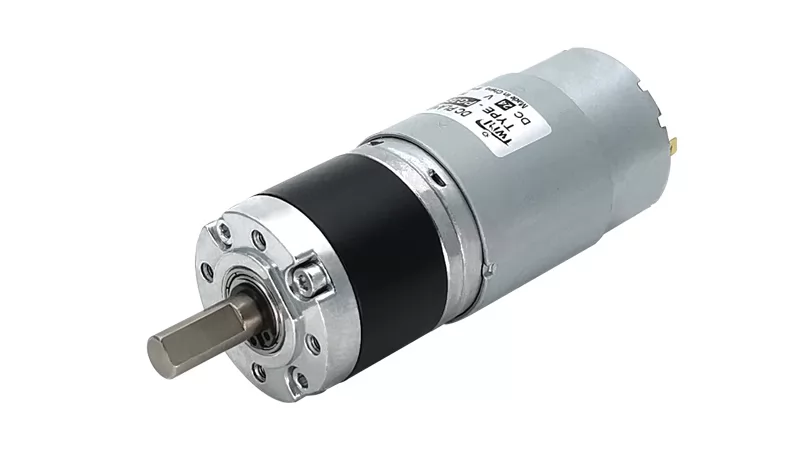 |
Engineered for consistent spreading and long service life in harsh outdoor environments.
|
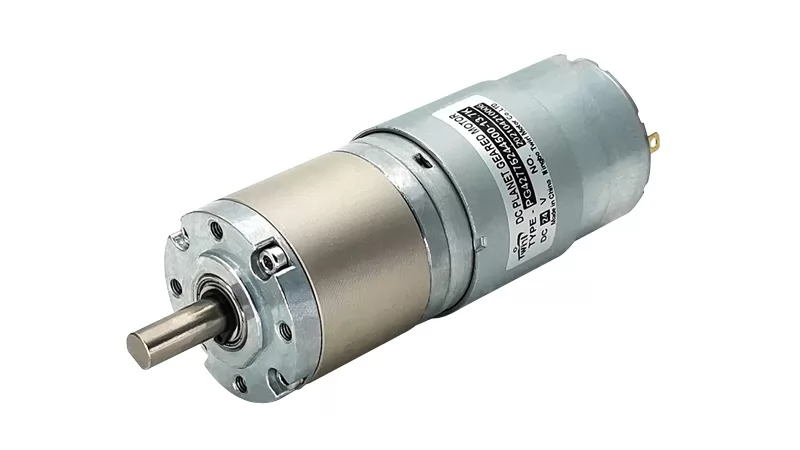 |
Heavy-duty power delivery for tractor-mounted and commercial agricultural systems.
|
For more advanced or autonomous agricultural vehicles requiring maintenance-free operation, you can also explore our 36mm BLDC Gear Motors that offer even higher efficiency and longer service life.
Outdoor Environment Requirements
Fertilizer equipment operates in some of the harshest conditions a motor will face. Look for motors that offer dust protection, moisture resistance, and corrosion resistance. Fertilizer is chemically corrosive, and motors without proper sealing will degrade quickly.
Common Mistakes When Choosing a Farm Equipment DC Motor
| Mistake 1 Choosing RPM instead of torque — speed alone doesn't tell you whether the motor can move the heavy fertilizer load. |
| Mistake 2 Ignoring fertilizer corrosion — standard motor housings degrade quickly under chemical exposure. |
| Mistake 3 Underestimating continuous duty cycles — motors sized for intermittent use overheat during long spreading runs. |
| Mistake 4 Selecting insufficient gearbox strength — choosing a weak gearbox that breaks down under pressure. That's why Toosyn’s planetary gear reducers are highly recommended. |
Why Agricultural Equipment Manufacturers Choose Toosyn
Custom shafts & OEM configurations built to your drawing
No redesigning your equipment around a stock motor. We machine shaft length, diameter, and mounting to match your existing spreader or seeder design — so integration doesn't cost you engineering time.
Multiple gear ratios for the torque-to-speed balance your application needs
Fertilizer spreaders, seed metering units, and precision farming equipment don't all need the same torque or RPM. We offer a range of reduction ratios so you get the right output for your specific load, not a generic motor that's over- or under-powered.
Advanced CNC machining centers for consistent tolerances at volume
Gear mesh precision directly affects motor lifespan and noise under field vibration. Tight, repeatable tolerances across every batch mean the motor that performs well in your prototype performs the same way in unit #10,000.
Rated for long service life in harsh outdoor conditions
Agricultural equipment runs through dust, moisture, temperature swings, and constant vibration. Our motors are built to hold up through full planting and harvest seasons without premature gear wear or seal failure.
In-house engineering & R&D support from spec sheet to sample
Send us your torque, speed, and mounting requirements — our engineering team works with you on motor selection or custom design, not just order fulfillment.
Flexible batch capacity, from prototype runs to full production volume
Whether you need 50 units to validate a new spreader design or 50,000 units for full-scale production, we scale output without you having to switch suppliers mid-project.
FAQ
What motor is used in a fertilizer spreader?
Most fertilizer spreaders use a DC gear motor, particularly planetary geared designs like the PG36555 series, selected for their combination of high torque, controllable speed, and compact size.
How much torque does an agricultural gear motor need?
It depends on equipment size — typically 15–30 kg·cm for small spreaders up to 120+ kg·cm for tractor-mounted systems like those supported by our PG42775 series.
What voltage is best for fertilizer spreaders?
12V suits smaller, battery-powered spreaders; 24V is generally better for heavy-duty or commercial agricultural systems due to lower current draw.
Can gear motors operate in dusty environments?
Yes, provided they're built with adequate dust protection. Standard motors without this protection will fail prematurely in fertilizer dust.
Which gear motor is best for precision farming equipment?
For precision farming, Planetary DC gear motors or BLDC gear motors equipped with encoders are best, since they provide consistent, controllable torque delivery required for accurate seeding and fertilizing.
|
Toosyn's high-performance Planetary DC Gear Motors (PG36555 & PG42775 Series) provide high torque, stable low-speed operation, and customizable gear ratios for fertilizer spreaders, seeders, and sprayers.
|
0
Comments
Leave a Comment
Your email address will not be published. Required fields are marked *
Name can't be empty
Email error!
Message can't be empty
😍
😜
😳
😌
😄
😘
😝
😒
😃
😚
😚
😛
😟
😧
😀
😉
😓
😱
😤
😣
😂
😥
😩
😠
😢
😭
😰
😨
😡
😆
😪
😅
😐
😇
😋
😴
👿
😕
😏
😷
😵
😟
😮
😯
😑
👧
👴
😧
😬
😾
👶
👱
👵
👸
🙀
👺
👦
👩
👨
😽
😿
🙈
💩
💥
💤
😼
😹
🙉
🔥
✨
💦
👎
✌
👆
👈
💪
💹
👍
👊
💴
💶
💷
💸
👉
💵
🙏
🌎
🏧
👏
💳
👇
💑
🙆
🙅
💁
👫
👭
🙎
🙇
👑
👔
Submit Comment
Most Popular
-
 Aug 21, 2025Which Motor Is Best for Electric Vehicle? A Complete Guide for 2026
 -
 Oct 16, 2025Top 10 DC Motor Manufacturers in China 2026
 -
 Dec 18, 2025The Ultimate Buyer's Guide to High Torque DC Motors
 -
 Apr 11, 2026Top 10 China Gear Motor Manufacturer in 2026


Laster Blogs
-
 Aug 20, 2026Why Planetary Gear Motors Offer Low Backlash for Precision Positioning
 -
 Aug 19, 2026Planetary Gear Ratio Calculation: How to Calculate the Right Gear Ratio for Your Motor
 -
 Aug 18, 2026Planetary Gearbox vs Spur Gearbox: Why Planetary Wins in Compact High-Torque Applications
 -
 Aug 17, 2026What Is a Planetary DC Gear Motor and How Does It Work?


Set A Consultation Today
Name can't be empty
Email error!
Send Your Message
*We respect your confidentiality and all
information are protected.


