How to Choose the Right Gear Motor for Ventilator Applications
Jul 30, 2026
Toosyn
_1785403098_WNo_1600d900.webp)
Selecting the wrong medical gear motor for a ventilator mechanism can create problems that go far beyond motor performance. Inconsistent positioning, unstable speed control, excessive noise, mechanical vibration, and premature wear can affect the reliability and overall performance of the entire respiratory system.
If you're developing a ventilator or respiratory equipment system, the gear motor you choose directly impacts how accurately valves adjust, how smoothly mechanisms operate, and how reliably the device performs through thousands of operating cycles. Unlike general industrial motors, ventilator applications require a precise balance of torque, speed control, low noise, compact design, and long-term operational stability.
This guide explains the key factors OEM engineers and procurement teams should evaluate when selecting a medical gear motor for ventilator applications — including torque requirements, encoder feedback, gear ratio, noise control, duty cycle, and precision motion requirements — and how Toosyn's Precision Encoder Series supports reliable motion control in medical device designs.
What Does a Ventilator Motor Need to Control?
Rather than starting from general ventilator theory, it's more useful to look at what the motor is actually responsible for inside the mechanism.
| Application | Motor Requirement |
|---|---|
| Airflow adjustment | Precise positioning |
| Valve control | Fine, controlled movement |
| Pump / actuator mechanism | Stable output torque |
| Oxygen regulation | Repeatable motion |
| Mechanical adjustment | Closed-loop control |
Across all of these functions, the common requirement isn't raw speed — it's accuracy, stability, and repeatability over long operating cycles.
How Do You Calculate the Required Motor Torque?
Before comparing motor datasheets, it helps to define the mechanical load the motor actually needs to drive. The core inputs are:
- Load
- Mechanical resistance
- Gear ratio
- Operating speed
- Acceleration
- Duty cycle
At a high level, the required output torque is a function of load torque plus an appropriate safety margin. However, that margin shouldn't be a fixed rule of thumb — it should be determined from the actual mechanical load, acceleration profile, friction, and duty cycle of your specific mechanism, since these vary significantly between ventilator designs.
How Does Gear Ratio Affect Ventilator Motor Performance?
Gear ratio is one of the most influential variables in a ventilator motor's behavior:
- Higher reduction ratio: higher output torque, lower output speed, and better positioning resolution — though efficiency can decrease as ratio increases.
- Lower reduction ratio: faster movement with less torque multiplication, suited to applications that need speed rather than torque.
Toosyn's planetary DC gear motors and planetary gearboxes are configurable across a range of reduction ratios, which makes it possible to balance torque, speed, and positioning resolution for a specific ventilator mechanism rather than settling for a fixed off-the-shelf ratio.
Brushed vs. Brushless Gear Motors for Medical Devices
| Factor | Brushed | Brushless |
|---|---|---|
| Cost | Lower | Higher |
| Control | Simpler | More complex |
| Maintenance | Brush wear over time | Lower mechanical wear |
| Continuous operation | Application dependent | Generally well suited |
| Integration | Simple | Requires a matched controller |
Neither type is universally "better." The appropriate motor type depends on the required operating life, control architecture, cost target, and duty cycle of the specific ventilator mechanism. Toosyn produces both brushed planetary DC gear motors and brushless gear motors, so the comparison can be made against real datasheets rather than general assumptions.
How to Select the Right Precision Encoder Gear Motor
Once the load, speed, and control requirements are defined, motor selection comes down to matching a small set of configurable parameters: encoder feedback, gear ratio, output torque, output speed, voltage, shaft configuration, mounting dimensions, noise requirements, and duty cycle.
For ventilator mechanisms requiring precise positioning and repeatable motion, a precision gear motor with encoder feedback can provide a practical foundation for closed-loop motion control. Relevant Toosyn product lines for this purpose include:
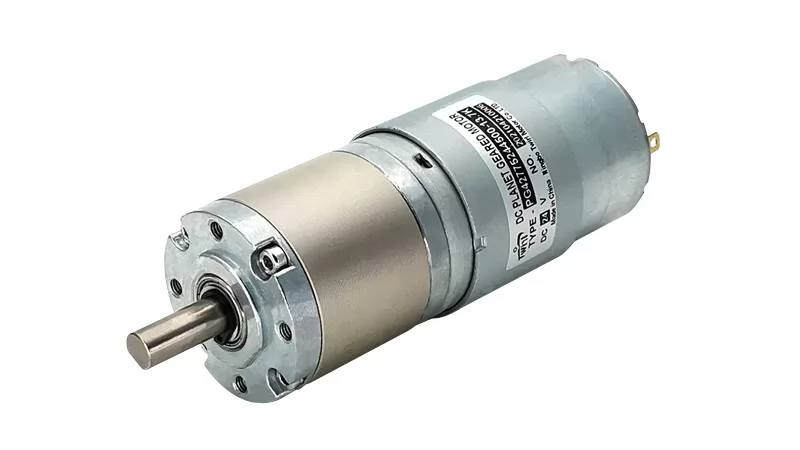 |
A planetary gear motor with an integrated encoder, designed for closed-loop positioning tasks such as ventilator valve or airflow control.
|
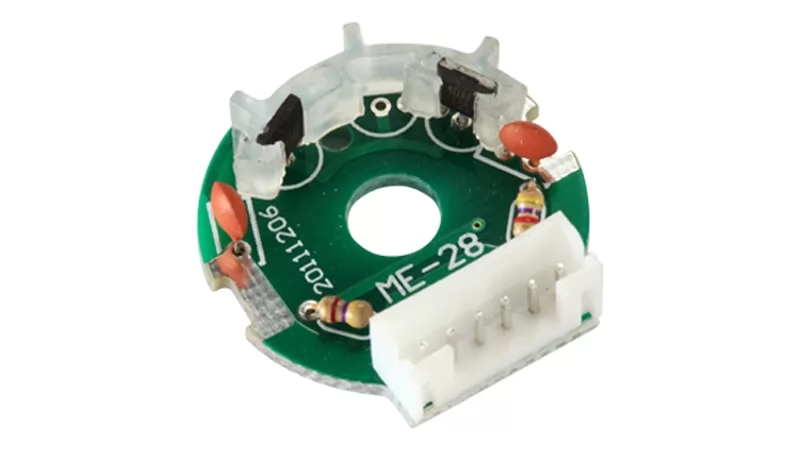 |
Hall-effect magnetic encoders that can be paired with gear motors to add position and speed feedback where a motor doesn't already include one.
|
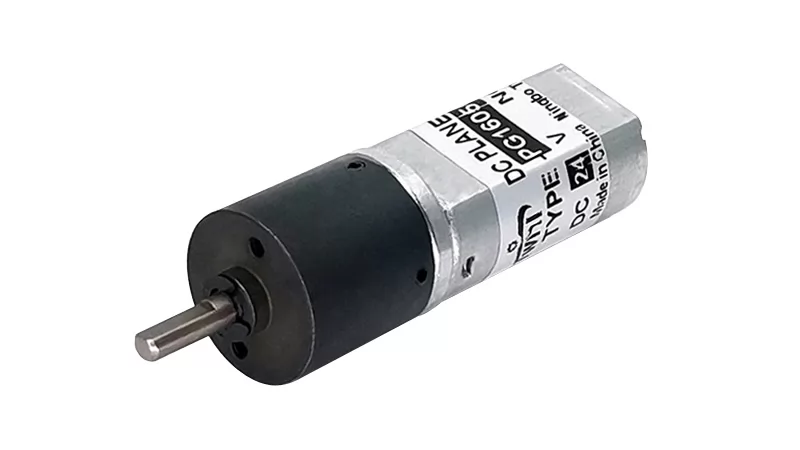 |
Versatile planetary DC gear motors designed for OEMs that need to define torque, speed, and resolution independently.
|
What Should OEMs Confirm Before Ordering a Medical Gear Motor?
Requesting "a price" alone rarely produces a usable quote for a precision application. Before reaching out, it helps to have the following parameters ready:
- Rated voltage (12V / 24V / other)
- Required output speed (RPM)
- Required output torque (N·m / kg·cm)
- Encoder requirement (resolution / feedback type)
- Installation dimensions
- Shaft requirements
- Operating cycle
- Noise requirement
- Expected lifetime
If some of these parameters aren't available yet, provide the load, movement range, target speed, voltage, and available installation space instead — Toosyn's engineers can help work out a suitable configuration from there.
Common Mistakes When Selecting a Ventilator Gear Motor
| Mistake 1Choosing torque without considering the required speed, resulting in a motor that can't reach target speed under load. |
| Mistake 2Selecting a motor without encoder feedback for a mechanism that actually needs closed-loop positioning. |
| Mistake 3Ignoring gearbox backlash, which shows up as positioning error even when the motor itself performs well. |
| Mistake 4Evaluating motor noise in isolation, without testing it as part of the full gearbox and mounting assembly. |
| Mistake 5Focusing only on unit price rather than total reliability and lifetime cost across the product's service life. |
In medical equipment, the lowest initial motor cost is not necessarily the lowest total cost.
Why Choose Toosyn Precision Encoder Gear Motors?
Precision encoder integration for accurate motion control
Ventilator mechanisms require more than basic motor rotation. Our precision encoder gear motors provide reliable position and speed feedback, helping OEM engineers achieve smoother motion control, repeatable positioning, and stable operation in demanding medical applications.
Custom gear ratios and configurations for your mechanism design
Every ventilator system has different load requirements, movement ranges, and installation constraints. We customize gear ratios, shaft dimensions, mounting structures, voltage options, and motor configurations to match your specific mechanical design — reducing redesign time and simplifying integration.
Low-noise operation for patient-focused environments
Motor noise and vibration can directly affect the user experience of medical equipment. Through optimized gearbox design, precision manufacturing, and controlled mechanical tolerances, our gear motors are designed to support quieter and smoother operation in medical device applications.
Consistent performance from prototype validation to mass production
Medical equipment requires reliable performance across every production unit. Advanced manufacturing processes and strict quality control ensure consistent torque output, speed characteristics, and mechanical accuracy from initial prototypes to high-volume production.
Long service life for continuous-duty medical applications
Ventilator systems often operate for extended periods and require dependable motion performance. Our gear motor solutions are engineered for durability, stable operation, and reduced wear under continuous working cycles.
Engineering support from motor selection to final integration
Choosing the right motor involves more than selecting torque and speed. Our engineering team works with OEM customers to evaluate load requirements, control methods, encoder feedback, installation space, and operating conditions to develop a suitable motor solution.
Flexible customization and production support for medical OEM projects
Whether you need prototype samples for design verification or large-scale production for commercial equipment, Toosyn provides flexible manufacturing support to help medical device companies move from concept validation to reliable mass production.
FAQ
What type of motor is used in ventilators?
Ventilators commonly use brushed or brushless DC gear motors paired with a planetary gearbox, often with an encoder added for position and speed feedback in mechanisms that require precise, repeatable motion.
Why does a ventilator need an encoder motor?
An encoder gives the control system direct feedback on actual position and speed, which supports closed-loop control and helps correct for load variation, friction changes, and mechanical clearance.
How do I choose the torque for a ventilator motor?
Start from the actual mechanical load, gear ratio, operating speed, acceleration, and duty cycle, then apply a safety margin based on those specific conditions rather than a fixed generic percentage.
What makes a gear motor suitable for medical devices?
Suitability depends on the combination of torque, speed, encoder resolution, backlash, noise level, operating voltage, duty cycle, dimensions, shaft design, and expected lifetime — evaluated together rather than individually.
How can motor noise be reduced in medical equipment?
Noise is influenced by gear design, gearbox ratio, motor speed, bearing quality, vibration, assembly accuracy, and load condition, so it should be assessed at the full assembly level rather than from the motor's isolated spec sheet.
Is an encoder necessary for ventilator precision control?
It's necessary for any mechanism that depends on closed-loop positioning or speed control. For simpler open-loop movements, it may not be required, but repeatability and drift correction depend on having feedback.
How does gear ratio affect ventilator motor performance?
A higher reduction ratio increases output torque and positioning resolution but lowers output speed and can reduce efficiency; a lower ratio favors speed over torque multiplication.
Can gear motors be customized for medical equipment?
Yes — gear ratio, encoder resolution, shaft configuration, voltage, and mounting dimensions can typically be configured around a specific mechanism rather than limited to a standard catalog configuration.
|
Have load, speed, voltage, or installation constraints for a ventilator mechanism? Share the details and Toosyn's engineers can help determine a suitable gear motor and encoder configuration.
Ventilator Application | Encoder & Brake | Planetary DC Gear Motor |
0
Comments
Leave a Comment
Your email address will not be published. Required fields are marked *
Name can't be empty
Email error!
Message can't be empty
😍
😜
😳
😌
😄
😘
😝
😒
😃
😚
😚
😛
😟
😧
😀
😉
😓
😱
😤
😣
😂
😥
😩
😠
😢
😭
😰
😨
😡
😆
😪
😅
😐
😇
😋
😴
👿
😕
😏
😷
😵
😟
😮
😯
😑
👧
👴
😧
😬
😾
👶
👱
👵
👸
🙀
👺
👦
👩
👨
😽
😿
🙈
💩
💥
💤
😼
😹
🙉
🔥
✨
💦
👎
✌
👆
👈
💪
💹
👍
👊
💴
💶
💷
💸
👉
💵
🙏
🌎
🏧
👏
💳
👇
💑
🙆
🙅
💁
👫
👭
🙎
🙇
👑
👔
Submit Comment
Most Popular
-
 Aug 21, 2025Which Motor Is Best for Electric Vehicle? A Complete Guide for 2026
 -
 Oct 16, 2025Top 10 DC Motor Manufacturers in China 2026
 -
 Dec 18, 2025The Ultimate Buyer's Guide to High Torque DC Motors
 -
 Apr 11, 2026Top 10 China Gear Motor Manufacturer in 2026


Laster Blogs
-
 Aug 20, 2026Why Planetary Gear Motors Offer Low Backlash for Precision Positioning
 -
 Aug 19, 2026Planetary Gear Ratio Calculation: How to Calculate the Right Gear Ratio for Your Motor
 -
 Aug 18, 2026Planetary Gearbox vs Spur Gearbox: Why Planetary Wins in Compact High-Torque Applications
 -
 Aug 17, 2026What Is a Planetary DC Gear Motor and How Does It Work?


Set A Consultation Today
Name can't be empty
Email error!
Send Your Message
*We respect your confidentiality and all
information are protected.


