How to Choose the Right Planetary Gear Motor for Automatic Door Openers
_1785747487_WNo_1600d900.webp)
Choosing the wrong automatic door opener motor doesn't usually fail on the first day. Instead, the problems appear over time—slow door movement, inconsistent opening speeds, excessive operating noise, motor overheating, and premature gearbox wear. For OEM manufacturers, these issues often lead to increased warranty costs, more service calls, and reduced customer satisfaction.
Whether you're designing an automatic sliding door, swing door, industrial access system, or smart entrance solution, selecting the right door drive motor determines how smoothly, quietly, and reliably the system performs throughout thousands of operating cycles. A motor might seem perfectly fine on the test bench, but real-world conditions—temperature fluctuations, dust, continuous daily cycles, and heavy door weights—quickly expose any engineering compromises.
This guide explains the key factors engineers and purchasing teams should evaluate when selecting a planetary gear motor door actuator, why planetary gearboxes outperform conventional gear systems, and how Toosyn's PG32 and PG36 series help OEM manufacturers build more reliable automatic door systems. Instead of just defining what a planetary gear motor is, we are going to focus on how to avoid automatic door motor selection failures and drastically reduce your after-sales service costs.
What Really Causes Automatic Door Motor Failures?
When an automatic door system fails in the field, the end-user usually blames the "motor." However, as any experienced OEM engineer knows, the root cause is rarely a burnt copper coil. The real culprits lie deeper in the mechanical integration, torque曲线, and duty cycle mismatches. If you want to lower your product return rate, you need to look past the surface and address the actual engineering failures.
1. Insufficient Starting Torque
The moment a door starts moving is when the motor faces the greatest mechanical resistance. This is due to static friction in the door rollers, tracks, and hinges. Many manufacturers only look at the "Rated Torque" on a motor datasheet. However, rated torque is the continuous torque the motor can handle during operation. For automatic doors, Starting Torque is far more critical. If the starting torque is too low, the door will stutter, jam, or fail to open entirely when subjected to slight wind resistance or dirty tracks.
2. Incorrect Gear Ratio
A common mistake is selecting a motor that spins fast but lacks the mechanical advantage to push a heavy door, or conversely, selecting a high-torque setup that moves the door at a frustratingly slow pace. The gear ratio dictates the balance between output torque (pushing force) and output speed (door travel time). An incorrectly matched gear ratio leads to either a door that cannot overcome initial friction or a door that slams into the endstops uncontrollably.
3. Ignoring Continuous Operating Cycles (Duty Cycle)
Not all automatic doors are used equally. A residential garage door might cycle 10 to 20 times a day. A hospital corridor door might cycle 1,000 times a day. A commercial supermarket entrance could see even more. If an OEM selects a door drive motor rated only for intermittent duty and installs it in a high-traffic environment, the motor windings will overheat, the gearbox grease will break down, and the system will suffer premature failure. Understanding the application's duty cycle is non-negotiable.
4. Poor Gearbox Durability
Over hundreds of thousands of cycles, the gears inside the motor take a beating. Standard spur gears suffer from point-contact stress, leading to rapid gear tooth wear, increased backlash, and grinding noises over time. If the gearbox durability is poor, the automatic door opener motor will become louder, the door movement will become jerky, and eventually, the gear teeth will strip entirely.
5. Wrong Motor Size and Thermal Management
Sometimes, the motor fails simply because it cannot dissipate heat fast enough. If the OEM design allocates too small a space for the door actuator, the motor operates in a near-enclosed environment with poor airflow. Combined with high ambient temperatures, the motor's thermal protection circuit will constantly trip, causing the door to stop mid-operation. Selecting the right motor size ensures proper heat dissipation for continuous, reliable operation.
Why Planetary Gear Motors Are Better Than Spur Gear Motors
For modern automatic door systems, the industry has steadily shifted away from traditional spur gear motors toward planetary gear motors. To understand why OEMs prefer a planetary gear motor door actuator, you have to look at the mechanical differences. In a standard spur gear system, power is transmitted sequentially from one gear to the next, placing the entire load on a single point of contact at any given time. A planetary gearbox, however, uses a central "sun" gear surrounded by multiple "planet" gears, all enclosed within an outer ring gear.
This design allows the load to be distributed across multiple gear teeth simultaneously. Below is a direct comparison of why planetary gear systems excel in door automation:
| Feature | Planetary Gear Motor | Spur Gear Motor |
|---|---|---|
| Torque Density | Higher torque in a smaller footprint | Lower torque, requires larger housing |
| Load Sharing | Multiple planet gears share the load equally | Single gear bears the entire load |
| Backlash | Lower backlash, precise positioning | Larger backlash, more play over time |
| Service Life | Longer life due to reduced gear wear | Faster wear, prone to tooth stripping |
| Efficiency | Higher power transfer efficiency | Lower efficiency due to friction |
| Size | Compact, co-axial input/output | Larger, offset shaft configuration |
Because automatic doors require high torque to move heavy glass or metal panels but have limited installation space, the compact planetary gear motor is the ideal solution. The co-axial design (where the input shaft and output shaft are aligned) saves valuable space inside the door header, while the load-sharing capability ensures the gearbox survives millions of opening cycles.
How to Select the Right Torque for an Automatic Door
One of the most common questions OEM engineers ask is, "How much torque does my automatic sliding door motor need?" The truth is, there is no single answer like "30Nm." Torque requirements are highly specific to the physical parameters of the door system. To select the correct high torque door actuator, you must calculate the dynamic forces acting on the door during operation.
Here are the primary deciding factors you must evaluate:
- Door Weight: Heavier doors require more torque to overcome inertia during startup. A 150kg industrial door demands significantly more starting torque than a 40kg residential glass door.
- Door Width: Wider doors create a longer lever arm, increasing the load on the drive mechanism and rollers.
- Opening Force (Friction): The rolling resistance of the guide rollers and the condition of the tracks dictate the baseline torque requirement. High-quality rollers reduce the required motor torque.
- Opening Speed: Faster opening speeds require higher acceleration, which exponentially increases the torque demand during the first few milliseconds of movement.
- Wind Load (Outdoor): For outdoor automatic gates or entrance systems, wind pressure acting on a large door panel can add massive resistance. The motor must have enough peak torque to overcome sudden gusts.
- Duty Cycle: Continuous operation generates heat. If the door cycles frequently, you need a motor with a higher torque buffer so it doesn't operate at its thermal limit constantly.
By accurately mapping these variables, engineers can select a door drive motor that provides sufficient starting and running torque without oversizing the unit, which wastes energy and increases costs.
Why Gear Ratio Is Just as Important as Motor Power
When purchasing teams source an automatic door opener motor, they usually ask one question: "How many watts is the motor?" However, focusing purely on wattage is a fundamental mistake. The power of the electric motor is only half the equation; the gear ratio determines how that power is translated into actual door movement.
The gear ratio dictates the trade-off between speed and torque. In a door automation system, the gear ratio directly influences:
- Output Torque (Pushing power)
- Output RPM (Door travel speed)
- Acceleration profile (Smoothness of start/stop)
- Door smoothness during transitions
If the gear ratio is too low, the output shaft spins too fast, but the torque is insufficient. The door will move quickly but will struggle to start when cold or when facing slight friction. It may even stall halfway. On the other hand, if the gear ratio is too high, the motor will have massive pushing power, but the door will move unbearably slow, leading to poor user experience and potential safety sensor issues.
Selecting the perfect gear ratio ensures the automatic door opens smoothly within the standard 2 to 4-second window, with enough torque margin to handle resistance without straining the motor windings.
Should You Prioritize Torque, Speed, or Noise?
Every OEM project has different priorities. You cannot maximize torque, speed, and silence simultaneously without significantly increasing costs. Understanding the application environment allows you to prioritize the right specifications for your specific product line.
- Hospital & Healthcare Facilities: Priority is Noise. Automatic doors in hospitals must operate almost silently to avoid disturbing resting patients, while still providing reliable access for beds and equipment.
- Hotels & Premium Offices: Priority is Quiet & Smoothness. A loud door motor ruins the luxury atmosphere of a hotel lobby. A low noise door motor is essential here.
- Factories & Industrial Access: Priority is Torque. Industrial doors are heavy, often made of solid metal or thick insulation. They require a heavy-duty swing door actuator that can push massive weights reliably.
- Commercial Buildings (Retail, Airports): Priority is Reliability & Duty Cycle. These doors open thousands of times a day. Consistent speed and long-term durability are more important than absolute silence.
- Residential (Smart Home): Priority is Cost & Compact Size. A residential automatic sliding door motor needs to be small enough to hide in a slim track while remaining affordable for consumer markets.
By defining your project's main priority early in the design phase, you can work with your motor supplier to tune the gear geometry, winding specs, and control logic to achieve the perfect balance for your specific application.
Outdoor vs Indoor Door Systems: Different Motor Requirements
An often-overlooked factor in motor selection is the operating environment. An automatic door designed for an indoor office building will fail rapidly if installed as an outdoor gate entrance without proper motor modifications. The planetary gearbox for door automation must be specified according to its environmental exposure.
Outdoor Door Systems
Outdoor applications, such as automatic yard gates, exterior sliding doors, and industrial access points, face harsh conditions:
- Rain & Humidity: The motor housing and shaft must feature high IP (Ingress Protection) ratings to prevent water from entering the gearbox, which causes rust and electrical shorts.
- Dust & Debris: Dust can penetrate standard seals and mix with the gearbox lubricant, creating an abrasive paste that rapidly wears down planetary gears.
- Low Temperature: Winter cold causes standard gearbox grease to thicken. If the wrong grease is used, the automatic gate motor gearbox will struggle to start, drawing high currents and potentially burning out the control board. Low-temperature specific lubricants must be specified.
Indoor Door Systems
Indoor applications are protected from the weather but come with their own strict engineering requirements:
- Noise: Because ambient noise is low indoors, any gear whine or motor hum is highly noticeable. Precision-machined planetary gears with optimized helical teeth are required.
- Compact: Indoor doors often have slim aluminum profiles. The motor must fit into tight spaces without protruding.
- Low Vibration: Excessive vibration can rattle the door tracks and glass panels. The motor must be dynamically balanced to ensure smooth, vibration-free transmission.
What OEM Engineers Should Confirm Before Selecting a Door Drive Motor
To avoid costly redesigns and warranty issues, OEM engineers must compile a comprehensive technical brief before sourcing a door drive motor. The more complete these parameters are, the more accurate the final motor selection will be. Use this checklist for your next automatic door project:
- □ Door type (Sliding, Swing, Folding, Revolving)
- □ Door weight (Total mass of the moving panel)
- □ Opening angle or travel distance
- □ Duty cycle (Cycles per day / per hour)
- □ Voltage (24VDC, 36VDC, 48VDC, or AC options)
- □ Available installation space (Maximum motor diameter and length)
- □ Required gear ratio
- □ Output speed (RPM at the output shaft)
- □ Output torque (Continuous and Peak)
- □ Shaft dimensions (Diameter, length, D-cut, or keyway)
- □ Mounting method (Flange, foot mount, clip-in)
- □ Encoder required? (Hall sensors, optical encoders for precise position feedback)
- □ Brake required? (Electromagnetic brake to hold the door in place when power is off)
When these parameters are clearly defined and communicated to your motor manufacturer, the engineering transition from prototype to mass production becomes seamless, eliminating the guesswork that usually leads to field failures.
Recommended Solution — PG32 & PG36 Planetary Gear Motors
Based on the rigorous requirements of modern automatic door systems, Toosyn has developed two flagship planetary gear motor series specifically engineered to address the common failures of door automation. Depending on your torque requirements and spatial constraints, the PG32 and PG36 series offer optimized solutions for OEMs.
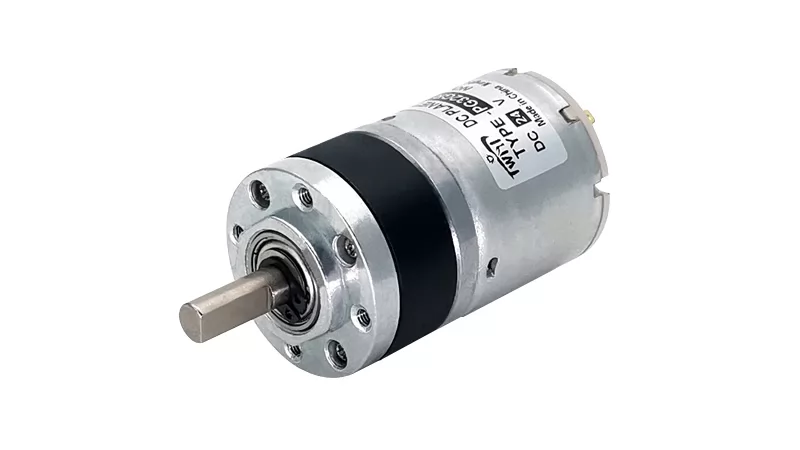 |
Toosyn PG32 Planetary Gear Motor
Best For: Smart doors, residential automatic sliding doors, compact actuators, and light commercial entrance systems.
The PG32 series is engineered for applications where space is highly restricted but smooth, quiet operation is required. Its 32mm diameter footprint fits perfectly into slim aluminum door profiles. Despite its compact size, the integrated planetary gearbox provides exceptional torque density and low backlash, ensuring smooth starts and stops without the jerky motion typical of smaller spur gear motors. It is the ideal OEM automatic door motor for residential smart home integrations. |
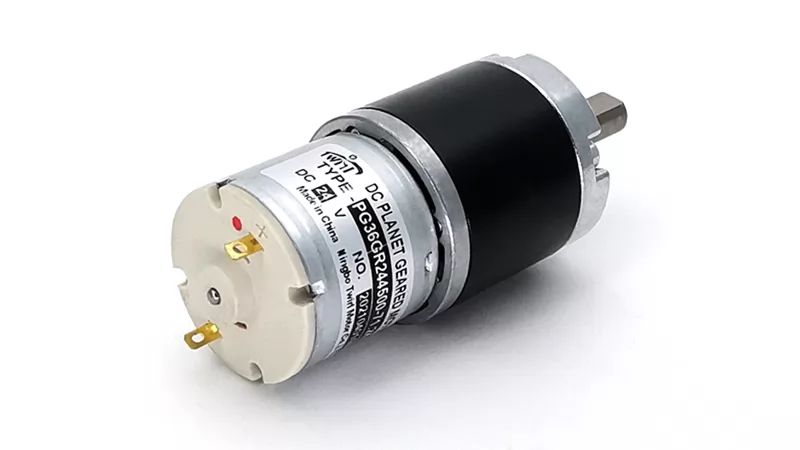 |
Toosyn PG36 Planetary Gear Motor
Best For: Commercial swing doors, heavy industrial access systems, and high-traffic automatic entrance solutions.
When your application requires pushing heavy glass panels or operating continuously in a commercial environment, the PG36 series delivers the necessary robust performance. The 36mm planetary gearbox utilizes high-grade steel gears and specialized low-temperature grease to handle high starting torque and continuous duty cycles. Its superior load-sharing design minimizes gear wear, drastically reducing noise over the product's lifespan and making it a premier swing door actuator for commercial buildings. |
Why Automatic Door Manufacturers Choose Toosyn
Selecting the right motor supplier is just as important as selecting the right motor specifications. At Toosyn, we do not just sell standard catalog parts; we partner with OEMs to engineer motion solutions that ensure their final door products succeed in the market. Here is why leading automatic door manufacturers rely on Toosyn:
|
Engineered around your door system—not the other way around Many suppliers offer only standard motors, leaving OEMs to redesign their mechanisms. We customize shaft dimensions, gear ratios, mounting interfaces, and electrical configurations so the motor fits your existing design instead of forcing engineering compromises. |
|
Planetary gearboxes built for millions of opening cycles Automatic doors may operate hundreds or even thousands of times every day. Our precision planetary gearboxes distribute loads across multiple gears, helping reduce wear, maintain smoother transmission, and extend service life under continuous operation. |
|
Consistent torque and motion across every production batch Prototype performance means little if production motors behave differently. Advanced CNC machining and controlled assembly processes help ensure consistent torque, speed, and gearbox quality from the first unit to large-volume production. |
|
Low-noise transmission for commercial environments Noise complaints are one of the most common service issues in automatic door systems. Optimized gear geometry and precision manufacturing help reduce mechanical noise while maintaining smooth door movement. |
|
Engineering support that starts before production Selecting an automatic door motor isn't simply matching voltage and RPM. Our engineers evaluate door weight, duty cycle, installation constraints, and application requirements to recommend the most suitable motor configuration before production begins. |
|
Flexible manufacturing from prototype to mass production Whether you're validating a new automatic door platform or scaling production globally, Toosyn supports both prototype quantities and high-volume manufacturing without changing suppliers as your project grows. |
Common Mistakes When Selecting an Automatic Door Opener Motor
Even experienced engineering teams can fall into common traps during the motor selection process. Avoiding these pitfalls will save your company thousands of dollars in warranty claims and product recalls:
| Mistake 01 Choosing peak torque only. Peak torque can only be sustained for a few seconds. If your door requires high starting torque frequently, relying on peak torque ratings will overheat and damage the motor. Always calculate based on continuous torque requirements with an adequate safety margin. |
| Mistake 02 Ignoring starting torque. Static friction is higher than dynamic friction. If the motor cannot break the initial inertia of the heavy door, the door will jam, triggering safety sensors and causing the system to fail its first cycle. |
| Mistake 03 Selecting the wrong gear ratio. A mismatch here means either a door that moves too slow, frustrating users, or a door that moves too fast and slams into the endstops, causing mechanical damage over time. |
| Mistake 04 Focusing only on motor price. Saving $2 on a cheaper door drive motor might cost you $20 in after-sales service, shipping, and brand reputation damage when the low-quality gears fail after 6 months in the field. |
| Mistake 05 Not considering duty cycle. Installing an intermittent-duty motor in a hospital corridor door is a guaranteed failure. Always match the motor's thermal capacity to the expected daily cycle count. |
| Mistake 06 Using spur gearboxes where planetary designs are more suitable. For heavy or high-traffic doors, standard spur gears will wear out quickly, leading to backlash, jerky movement, and eventual gear failure. Planetary gears provide the necessary durability. |
FAQ: Automatic Door Motor Selection
What type of motor is best for an automatic door opener?
A brushed or brushless DC motor paired with a precision planetary gearbox is generally the best choice. This combination offers high starting torque, precise speed control, compact size, and long operational life, which are essential for reliable automatic door systems.
Why use a planetary gear motor instead of a spur gear motor?
Planetary gear motors distribute the load across multiple planet gears, resulting in higher torque density, lower backlash, and significantly longer service life compared to standard spur gears. They are also much more compact, making them ideal for fitting inside automatic door headers.
How much torque does an automatic door opener need?
Torque requirements depend on door weight, width, roller friction, and wind load. A residential sliding door may only require 5-10Nm, while a heavy commercial swing door might need 30Nm or more. Always calculate starting torque based on static friction, not just running torque.
What gear ratio is best for automatic door systems?
The optimal gear ratio balances speed and torque. For standard automatic sliding doors, a gear ratio that achieves an opening speed of 0.2 to 0.5 meters per second while providing enough starting torque is ideal. This usually falls between 1:15 and 1:50, depending on the motor's base RPM.
How long should a door drive motor last?
A high-quality OEM automatic door motor should be engineered to last between 1 million to 3 million opening cycles. Using planetary gears and proper thermal management ensures the motor maintains performance throughout this lifespan.
Can planetary gear motors operate continuously?
Yes, if specified correctly. When designing for high-traffic areas like hospitals or airports, OEMs must select a motor rated for continuous duty (S1 or S2 duty cycles) with adequate thermal dissipation to prevent overheating during non-stop operation.
Are PG32 and PG36 suitable for sliding doors?
Yes. The Toosyn PG32 series is excellent for compact residential and light commercial sliding doors, while the PG36 series handles heavier commercial sliding doors. Both can be customized with specific output shafts and mounting flanges for sliding mechanisms.
Can Toosyn customize automatic door motors for OEM projects?
Absolutely. We customize shaft dimensions, gear ratios, voltage, encoders, and mounting interfaces to fit your specific door system design. Our engineering team works directly with OEMs to ensure seamless integration from prototype to mass production.
|
Stop compromising on door performance and warranty costs. Upgrade your automatic door systems with Toosyn’s precision PG32 and PG36 planetary gear motors. Engineered for millions of cycles, customized for your exact specifications.
|
0
Comments
Leave a Comment
Your email address will not be published. Required fields are marked *
Name can't be empty
Email error!
Message can't be empty
😍
😜
😳
😌
😄
😘
😝
😒
😃
😚
😚
😛
😟
😧
😀
😉
😓
😱
😤
😣
😂
😥
😩
😠
😢
😭
😰
😨
😡
😆
😪
😅
😐
😇
😋
😴
👿
😕
😏
😷
😵
😟
😮
😯
😑
👧
👴
😧
😬
😾
👶
👱
👵
👸
🙀
👺
👦
👩
👨
😽
😿
🙈
💩
💥
💤
😼
😹
🙉
🔥
✨
💦
👎
✌
👆
👈
💪
💹
👍
👊
💴
💶
💷
💸
👉
💵
🙏
🌎
🏧
👏
💳
👇
💑
🙆
🙅
💁
👫
👭
🙎
🙇
👑
👔
Submit Comment
Most Popular
-
 Aug 21, 2025Which Motor Is Best for Electric Vehicle? A Complete Guide for 2026
 -
 Oct 16, 2025Top 10 DC Motor Manufacturers in China 2026
 -
 Dec 18, 2025The Ultimate Buyer's Guide to High Torque DC Motors
 -
 Apr 11, 2026Top 10 China Gear Motor Manufacturer in 2026


Laster Blogs
-
 Aug 20, 2026Why Planetary Gear Motors Offer Low Backlash for Precision Positioning
 -
 Aug 19, 2026Planetary Gear Ratio Calculation: How to Calculate the Right Gear Ratio for Your Motor
 -
 Aug 18, 2026Planetary Gearbox vs Spur Gearbox: Why Planetary Wins in Compact High-Torque Applications
 -
 Aug 17, 2026What Is a Planetary DC Gear Motor and How Does It Work?


Set A Consultation Today
Name can't be empty
Email error!
Send Your Message
*We respect your confidentiality and all
information are protected.


