How to Choose the Right Planetary Gear Motor for Medical Bed & Recliner Actuators
Aug 06, 2026
Toosyn
_1786001637_WNo_1600d900.webp)
Selecting the wrong medical bed motor can affect far more than mechanical performance. Excessive operating noise, unstable positioning, insufficient lifting force, or the inability to hold position during a power loss can all reduce patient comfort, increase maintenance requirements, and compromise equipment reliability.
Modern medical beds, nursing beds, examination tables, and healthcare recliners rely on compact actuator systems that must deliver smooth movement, stable torque, quiet operation, and reliable position holding — often across years of daily use in hospitals, ICUs, rehabilitation centers, and home care settings.
This guide explains what OEM manufacturers should evaluate when selecting a medical bed motor or recliner actuator motor, why planetary gear motors are widely used in healthcare equipment, and how Toosyn's Mid-Torque Series with Brake supports safe, reliable actuator design.
What Performance Matters Most in Medical Bed Actuators?
Before comparing motor series or torque ratings, it helps to define what actually matters inside a medical bed or recliner actuator. The table below summarizes the requirements OEM engineers weigh most heavily when specifying a healthcare gear motor.
| Requirement | Why It Matters |
|---|---|
| Stable torque | Ensures smooth, controlled lifting under patient load |
| Low noise | Protects patient comfort, especially during night use |
| Position holding | Maintains safety if power is lost mid-adjustment |
| Compact design | Fits inside space-limited actuator housings |
| Long service life | Withstands years of continuous daily use |
| Smooth start & stop | Keeps adjustment comfortable, not abrupt |
| Reliable braking | Prevents unintended movement of the bed section |
Why Planetary Gear Motors Are Preferred for Medical Actuators
Among the transmission types available for compact actuator design, planetary gear motors have become the default choice for medical bed motor and recliner actuator motor applications. Their construction offers a combination of advantages that align closely with the demands of healthcare equipment:
- Higher torque density — multiple planet gears share the load simultaneously, so a planetary gearbox delivers more torque from a smaller housing than a single-stage transmission.
- Compact footprint — the coaxial, in-line layout keeps the motor and gearbox within the actuator tube's diameter, which matters when installation space is limited.
- Smooth power transmission — even tooth engagement around the gear set reduces torque ripple, translating into steadier, more predictable motion.
- Lower backlash — a tighter mesh between sun, planet, and ring gears supports more precise, repeatable positioning.
- Longer service life — distributing load across multiple gear contacts reduces wear concentration on any single tooth.
- Reliable, consistent transmission — the enclosed, self-centering gear arrangement holds up well under the repetitive, long-duration duty cycles typical of hospital and home-care equipment.
Why Holding Brake Matters More Than Maximum Torque
It's tempting to shortlist motors by peak torque or peak speed alone, but for a medical bed motor or recliner actuator motor, what happens the moment power is interrupted matters just as much — arguably more. Without a holding brake, a raised backrest, an elevated leg rest, or a height-adjusted frame can gradually lower under the patient's own weight the instant motor power is cut, whether from a planned shutdown, a power outage, a loose connection, or a fault condition.
That's not a minor inconvenience — it's a patient safety issue. This is why brake integration should be treated as a core selection criterion for healthcare actuator motors, not an optional accessory added after the fact.
Toosyn's brake-equipped motors use a power-off, fail-safe electromagnetic brake mounted directly on the motor. The brake engages automatically the instant supply power is removed, holding the load in place, and releases only while the motor is powered — engaging in roughly 20ms and disconnecting in roughly 25ms, with a rated holding torque of 1.5N·m at 12/24VDC. Because the resting state is "engaged," the actuator fails safe rather than failing open.
How Much Torque Does a Medical Bed Need?
There's no single torque figure that applies to every medical bed or recliner design, and treating "how many kg·cm" as a standalone spec can lead to a motor that's over- or under-sized. Torque requirements come from several variables working together:
- Patient weight range the bed or chair is rated to support
- Mechanism design — whether the actuator drives a push-rod, a lever linkage, or a scissor mechanism
- Lead screw pitch, which sets the mechanical advantage between motor rotation and linear travel
- Linkage geometry, since torque demand changes through the range of motion
- Gear reduction ratio built into the gearbox
- Safety factor engineered in above the calculated working load
- Duty cycle — how often the actuator moves and how long each cycle lasts
This is why Toosyn's planetary gear motor lineup spans a wide torque range rather than offering a single fixed rating — from roughly 1kg·cm on compact 16mm frames up to 400kg·cm on the 56mm brake-equipped series used in bed and recliner actuators. Rather than reading a torque number off a spec sheet in isolation, our engineering team works through actuator load, mechanism geometry, and duty cycle directly with each OEM customer to confirm the right torque and gear ratio before recommending a motor.
Why Quiet Operation Is Critical in Healthcare Equipment
Hospital wards, ICUs, and home care bedrooms are noise-sensitive environments, especially overnight, when a bed adjustment is more likely to disturb a sleeping patient or a roommate. Audible motor whine or gear noise is one of the most common complaints raised about electric beds in shared-ward settings, and it can quietly become a differentiator between competing bed models during procurement evaluation.
Planetary gearboxes help here structurally: distributing load across multiple simultaneous gear contacts — rather than the single point of contact typical of a worm or spur gear pair — reduces the vibration generated at each mesh point, which is part of why planetary transmission is the standard choice for a low noise medical actuator.
Smooth Motion Improves Patient Comfort
Patients feel every movement of a bed or recliner directly, so abrupt starts and stops aren't just a mechanical detail — they transmit a noticeable jolt through the frame, which can be uncomfortable or even painful for post-surgical or limited-mobility patients. Controlled acceleration and deceleration, low gear backlash, and precise tooth engagement work together to keep motion gradual and predictable rather than jerky, supporting the actuator's role as a patient positioning motor rather than just a mechanical lift.
Continuous Reliability for Daily Healthcare Use
Medical bed and recliner actuators don't need to be fast, but they do need to be consistent. A bed section might move only a few dozen times a day, but across years of service that adds up to hundreds of thousands of actuations — and the motor needs to deliver the same smooth, quiet, controlled movement on cycle 200,000 as it did on cycle one. In a hospital or care facility, downtime on a single actuator can mean an unusable bed and disrupted patient care, so duty life and batch-to-batch manufacturing consistency matter just as much as any individual torque or speed spec.
Recommended Solution — Mid-Torque Planetary Gear Motor with Brake
For hospital beds, nursing beds, dialysis chairs, medical recliners, and rehabilitation equipment, Toosyn recommends the PG56ZY58 series — a 56mm planetary DC gear motor built with an integrated power-off holding brake as standard.
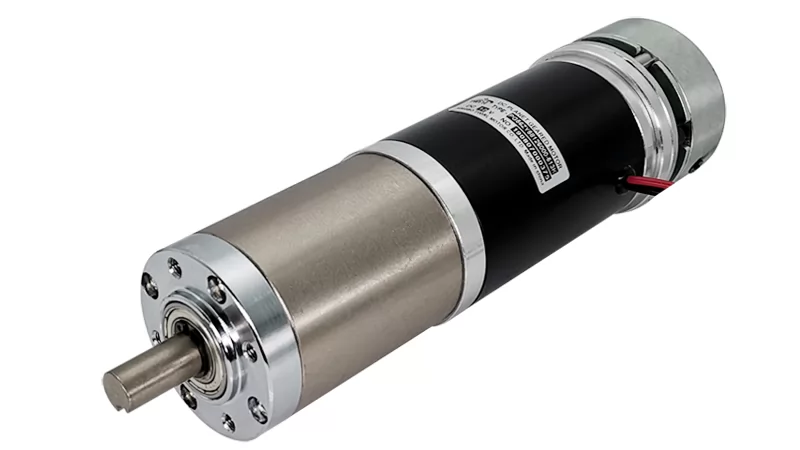 |
PG56ZY58 Series — 56mm Mid-Torque Planetary Gear Motor with Brake
Combines a 56mm planetary gearbox, ZY58 brushed DC motor, and an integrated power-off electromagnetic brake in one compact assembly — built for actuators that must hold their position the instant power is lost.
|
For actuator systems that synchronize multiple motors — such as a bed with independent backrest, leg rest, and height adjustment moving in coordination, or Trendelenburg positioning — the same platform is also available as the PG56ZY58 series with encoder and brake, adding rotary position feedback alongside fail-safe holding. For lighter-duty applications such as compact recliners, the 42–45mm planetary DC gear motor series offers a smaller footprint at a lower torque range.
Why Medical Equipment Manufacturers Choose Toosyn
|
Brake-equipped solutions for secure position holding. Medical beds and recliners must remain stable after adjustment, even when power is removed. Our integrated brake solutions help prevent unintended movement and support overall equipment safety. |
|
Smooth and quiet motion for patient comfort. Patients experience every movement of a medical bed or recliner directly. Precision planetary gearboxes support smoother acceleration, reduced vibration, and quieter operation in healthcare environments. |
|
Compact motors for space-constrained actuator systems. Medical actuator assemblies often have limited installation space. Our compact planetary gear motors deliver reliable torque while giving OEM engineers more design flexibility. |
|
Consistent quality across every production batch. Healthcare equipment manufacturers need repeatable performance run after run. IATF16949-certified processes, CNC machining centers, and automated production lines help maintain stable torque, motion characteristics, and gearbox quality at scale. |
|
OEM customization for different healthcare equipment. Different medical beds and recliners call for different stroke lengths, mounting methods, output shafts, and torque levels. We configure motors to match your specific actuator design. |
|
Engineering support from prototype through production. Our engineering team works directly with OEM customers to evaluate actuator loads, duty cycles, installation constraints, and braking requirements before recommending a motor solution. |
Common Mistakes When Selecting a Medical Bed Motor
| Mistake 1 — Ignoring Brake Requirements Assuming any motor that resists back-driving while powered is "good enough," without confirming what happens — and how quickly — when power is actually lost. |
| Mistake 2 — Choosing on Peak Torque Alone Sizing a motor around a single maximum torque number without accounting for duty cycle, safety margin, or the actual load the mechanism sees across its full range of motion. |
| Mistake 3 — Ignoring Patient Comfort Prioritizing raw speed or unit cost over smooth acceleration and deceleration, which later shows up as jolting, uncomfortable adjustments for the patient. |
| Mistake 4 — Selecting Oversized Motors Over-specifying torque and power "just in case," which adds unnecessary cost, size, and weight to the actuator without a real operational benefit. |
| Mistake 5 — Overlooking Operating Noise Evaluating motors purely on electrical and mechanical specs without testing real-world audible noise in the kind of quiet room a ward or bedroom actually is. |
| Mistake 6 — Ignoring Installation Space Selecting a motor before confirming it actually fits the actuator housing, mounting geometry, and available stroke length, leading to late-stage redesign. |
Frequently Asked Questions
What motor is used in electric medical beds?
Most electric medical beds, nursing beds, and healthcare recliners use small DC planetary gear motors to drive the linear actuators behind backrest, leg rest, height, and tilt adjustment. Planetary gear motors are preferred because they pack high torque output into a housing compact enough to fit inside the actuator tube.
Why use a planetary gear motor in healthcare actuators?
Planetary gear motors deliver higher torque density, smoother power transmission, and lower backlash than spur or worm gear alternatives, all within a compact footprint — a combination that supports the smooth, quiet, precise movement medical bed and recliner actuators require.
Why is a holding brake important?
A holding brake keeps the actuator in position the instant motor power is interrupted. Without one, a raised or reclined section can drift downward under the patient's weight during a power loss, which is a safety concern rather than a minor inconvenience.
How much torque does a medical bed actuator need?
There's no single number that applies to every design. Required torque depends on patient weight range, mechanism type, lead screw pitch, gear reduction ratio, safety margin, and duty cycle — which is why torque should be calculated for each actuator rather than assumed from a spec sheet alone.
How can medical bed motors operate quietly?
Noise is reduced through the planetary gearbox's multiple simultaneous tooth contacts (versus the single-point contact of many gear types), tight manufacturing tolerances, appropriate lubrication, and controlled acceleration and deceleration profiles that avoid abrupt torque changes.
Can planetary gear motors be customized?
Yes. Voltage, gear ratio, output shaft, mounting configuration, encoder and brake integration, wiring harnesses, and sealing can all be configured to match a specific actuator design and healthcare application.
Are brake-equipped motors suitable for recliners?
Yes. Medical recliners, dialysis chairs, and infusion chairs benefit from the same fail-safe position holding as hospital beds, particularly for backrest and leg rest sections that need to stay in place if power is interrupted mid-adjustment.
What is the service life of a medical actuator motor?
Healthcare actuators are typically cycled dozens of times per day but need to remain reliable across years of service and hundreds of thousands of actuations, so duty life and manufacturing consistency are evaluated alongside torque and noise specifications.
|
Looking for a reliable planetary gear motor for medical beds or recliner actuators? Share your actuator load, stroke mechanism, operating voltage, installation space, duty cycle, and braking requirements — our engineering team will recommend the most suitable Mid-Torque Series with Brake configuration for your healthcare application.
Email: sales@toosyn.com
Phone: +86-574-8301 1768 Partner with Toosyn for reliable, low-noise, and precision planetary gear motors for medical bed and recliner actuator systems. |
0
Comments
Leave a Comment
Your email address will not be published. Required fields are marked *
Name can't be empty
Email error!
Message can't be empty
😍
😜
😳
😌
😄
😘
😝
😒
😃
😚
😚
😛
😟
😧
😀
😉
😓
😱
😤
😣
😂
😥
😩
😠
😢
😭
😰
😨
😡
😆
😪
😅
😐
😇
😋
😴
👿
😕
😏
😷
😵
😟
😮
😯
😑
👧
👴
😧
😬
😾
👶
👱
👵
👸
🙀
👺
👦
👩
👨
😽
😿
🙈
💩
💥
💤
😼
😹
🙉
🔥
✨
💦
👎
✌
👆
👈
💪
💹
👍
👊
💴
💶
💷
💸
👉
💵
🙏
🌎
🏧
👏
💳
👇
💑
🙆
🙅
💁
👫
👭
🙎
🙇
👑
👔
Submit Comment
Most Popular
-
 Aug 21, 2025Which Motor Is Best for Electric Vehicle? A Complete Guide for 2026
 -
 Oct 16, 2025Top 10 DC Motor Manufacturers in China 2026
 -
 Dec 18, 2025The Ultimate Buyer's Guide to High Torque DC Motors
 -
 Apr 11, 2026Top 10 China Gear Motor Manufacturer in 2026


Laster Blogs
-
 Aug 20, 2026Why Planetary Gear Motors Offer Low Backlash for Precision Positioning
 -
 Aug 19, 2026Planetary Gear Ratio Calculation: How to Calculate the Right Gear Ratio for Your Motor
 -
 Aug 18, 2026Planetary Gearbox vs Spur Gearbox: Why Planetary Wins in Compact High-Torque Applications
 -
 Aug 17, 2026What Is a Planetary DC Gear Motor and How Does It Work?


Set A Consultation Today
Name can't be empty
Email error!
Send Your Message
*We respect your confidentiality and all
information are protected.


