How to Choose the Right Planetary Gear Motor for Robotic Arm Joints
Jul 31, 2026
Toosyn
_1785490220_WNo_1600d900.webp)
Robotic arm performance depends on far more than the controller or software. In many cases, positioning errors, vibration, poor repeatability, or premature joint wear can be traced back to one overlooked component—the gear motor.
Choosing the wrong planetary gear motor can lead to excessive backlash, insufficient torque under load, unstable motion, overheating during continuous operation, and frequent maintenance. These issues not only reduce robot accuracy but also increase development costs and delay product launches.
Whether you're developing an industrial robot, collaborative robot (cobot), service robot, or AGV manipulator, selecting the right planetary gear motor for robotic arm joints is critical to achieving smooth, precise, and reliable motion.
This guide explains the key factors OEM engineers should evaluate when selecting a robot joint actuator motor, and how Toosyn's PG28395 Precision Planetary Gear Motor with Encoder helps meet the demands of modern robotics.
What Does a Robot Joint Gear Motor Need?
Unlike standard industrial applications, robotic joints require a balance of torque, precision, compact size, and long-term reliability.
Before selecting a motor, engineers typically evaluate the following requirements:
| Requirement | Why It Matters |
|---|---|
| High torque density | Supports heavier payloads in compact joints |
| Low backlash | Improves positioning accuracy and repeatability |
| Encoder feedback | Enables closed-loop motion control |
| Smooth transmission | Reduces vibration and improves trajectory tracking |
| Continuous-duty capability | Maintains stable performance during long operating cycles |
| Compact dimensions | Fits limited installation space inside robot joints |
A motor that performs well in only one of these areas rarely delivers the overall performance required for robotic applications.
Why Planetary Gear Motors Are Preferred for Robotic Arms
Planetary gear motors have become the preferred solution for robotic joints because they provide an excellent combination of torque output, efficiency, and compact size.
Compared with conventional gearboxes, planetary gear systems offer:
- Higher torque output in a smaller package
- Better load distribution across multiple gears
- Improved transmission efficiency
- Lower backlash for more accurate positioning
- Greater durability under continuous operation
These advantages make planetary gear motors suitable for applications such as:
- Industrial robot joints
- Collaborative robots (Cobots)
- Service robots
- Inspection robots
- Medical robots
- Mobile robot manipulators
How Much Torque Does a Robot Joint Need?
One of the most common mistakes is selecting a motor based only on maximum torque.
The required torque depends on several factors:
- Payload weight
- Arm length
- Joint location (shoulder, elbow, wrist)
- Desired acceleration
- Operating speed
- Safety margin
For example:
| Robot Joint | Typical Requirement |
|---|---|
| Wrist Joint | High precision, lower torque |
| Elbow Joint | Medium torque with smooth control |
| Shoulder Joint | High continuous torque |
| Heavy-duty Manipulator | High torque with long duty cycles |
Instead of choosing the largest available motor, engineers should calculate the required continuous output torque based on the actual application.
Should You Choose an Encoder?
For most robotic arm joints, the answer is yes.
An encoder provides real-time feedback that allows the controller to monitor the motor's actual position and speed instead of relying on estimated values.
Encoder feedback supports:
- Precise positioning
- Stable speed control
- Closed-loop servo systems
- Smooth acceleration and deceleration
- Improved repeatability
Without encoder feedback, even a high-quality gearbox may not deliver the positioning accuracy required for advanced robotic applications.
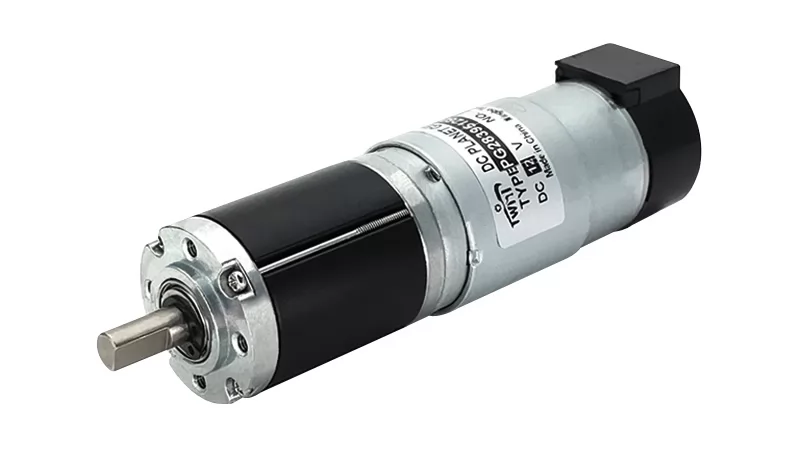
Recommended Solution: PG28395 Precision Planetary Gear Motor with Encoder
For robotic arm joints requiring compact size, precise positioning, and reliable operation, the PG28395 Precision Planetary Gear Motor with Encoder offers an excellent balance of performance and flexibility.
|
Key features include:
Typical applications include robotic arms, collaborative robots, service robots, inspection equipment, and other precision automation systems. |
 |
Why Robotics OEMs Choose Toosyn
|
Custom configurations built around your robot design Every robotic joint has different torque, speed, mounting, and dimensional requirements. We customize gear ratios, shaft dimensions, encoder options, voltages, and mounting interfaces to fit your design, reducing integration work and shortening development time. |
|
Precision manufacturing for consistent motion performance Stable robot motion depends on consistent gearbox quality. Advanced CNC machining and precision assembly help maintain tight tolerances, supporting smoother transmission, lower backlash, and reliable positioning from prototype to production. |
|
Encoder solutions for closed-loop robotic control Position and speed feedback are essential in modern robotics. Our encoder-equipped gear motors simplify integration with servo and motion control systems while improving positioning accuracy and repeatability. |
|
Engineering support beyond standard catalogs Choosing a robotic joint motor involves more than selecting voltage and torque. Our engineering team works with OEM customers to evaluate payload, joint location, operating speed, duty cycle, installation space, and control requirements to recommend the most suitable motor solution. |
|
Flexible production from prototype to mass manufacturing Whether you're validating a new robotic platform or preparing for high-volume production, Toosyn provides flexible manufacturing capacity while maintaining consistent quality across every production batch. |
Common Mistakes When Selecting a Robot Joint Motor
Avoid these common selection errors. Considering these factors early can significantly reduce development time and improve the long-term reliability of your robotic system.
| Common Mistake Choosing peak torque instead of continuous torque. Motors sized only for brief peak loads will quickly overheat and degrade during standard robotic duty cycles. |
| Common Mistake Ignoring gearbox backlash. Focusing purely on power while ignoring backlash leads to compounding positioning errors at the end-effector. |
| Common Mistake Selecting the wrong gear ratio. Choosing a ratio without analyzing duty cycles and speed targets can result in a motor that either cannot reach the required speed or lacks the necessary holding torque. |
| Common Mistake Overlooking encoder requirements. Attempting to run precision robotic joints via open-loop estimation instead of genuine encoder feedback drastically limits accuracy. |
| Common Mistake Focusing only on motor size instead of overall performance. A motor that fits the footprint but lacks thermal dissipation or load capacity will fail prematurely. |
| Common Mistake Purchasing a standard motor that requires major mechanical redesign. Not utilizing OEM customization often leads to bulky adapters and unnecessary weight in the joint architecture. |
Final Thoughts
Selecting the right planetary gear motor for robotic arm joints is about more than achieving sufficient torque. Precision, repeatability, backlash, encoder integration, gear ratio, and continuous-duty performance all contribute to the overall performance of the robot.
|
If you're developing a new robotic platform, providing key application details—such as payload, joint location, required speed, operating voltage, and installation space—allows Toosyn's engineering team to recommend the most suitable PG28395 Precision Planetary Gear Motor with Encoder for your project, helping you reduce development time while improving motion accuracy and system reliability.
|
0
Comments
Leave a Comment
Your email address will not be published. Required fields are marked *
Name can't be empty
Email error!
Message can't be empty
😍
😜
😳
😌
😄
😘
😝
😒
😃
😚
😚
😛
😟
😧
😀
😉
😓
😱
😤
😣
😂
😥
😩
😠
😢
😭
😰
😨
😡
😆
😪
😅
😐
😇
😋
😴
👿
😕
😏
😷
😵
😟
😮
😯
😑
👧
👴
😧
😬
😾
👶
👱
👵
👸
🙀
👺
👦
👩
👨
😽
😿
🙈
💩
💥
💤
😼
😹
🙉
🔥
✨
💦
👎
✌
👆
👈
💪
💹
👍
👊
💴
💶
💷
💸
👉
💵
🙏
🌎
🏧
👏
💳
👇
💑
🙆
🙅
💁
👫
👭
🙎
🙇
👑
👔
Submit Comment
Most Popular
-
 Aug 21, 2025Which Motor Is Best for Electric Vehicle? A Complete Guide for 2026
 -
 Oct 16, 2025Top 10 DC Motor Manufacturers in China 2026
 -
 Dec 18, 2025The Ultimate Buyer's Guide to High Torque DC Motors
 -
 Apr 11, 2026Top 10 China Gear Motor Manufacturer in 2026


Laster Blogs
-
 Aug 20, 2026Why Planetary Gear Motors Offer Low Backlash for Precision Positioning
 -
 Aug 19, 2026Planetary Gear Ratio Calculation: How to Calculate the Right Gear Ratio for Your Motor
 -
 Aug 18, 2026Planetary Gearbox vs Spur Gearbox: Why Planetary Wins in Compact High-Torque Applications
 -
 Aug 17, 2026What Is a Planetary DC Gear Motor and How Does It Work?


Set A Consultation Today
Name can't be empty
Email error!
Send Your Message
*We respect your confidentiality and all
information are protected.


