How to Select a DC Gear Motor for Automotive Power Tailgate
_1785141072_WNo_1600d900.webp)
Choosing the right DC gear motor for an automotive power tailgate is a decision that runs through nearly every performance metric an OEM cares about: safety, torque, reliability, noise, efficiency, and smart control. A power tailgate motor doesn't just open and close a panel — it holds position against gravity, reverses instantly when it senses an obstruction, and does this thousands of times over a vehicle's service life without draining the battery or drawing complaints about gear whine. Getting the automotive gear motor 12V 24V decision, the gearbox architecture, and the encoder strategy right the first time is far cheaper than re-engineering an actuator after a program has already launched.
This guide is written from an engineering sourcing perspective, for teams specifying or re-evaluating a gear motor for a power tailgate or liftgate program. It walks through how these systems work end to end, how to calculate the torque you actually need, why a low noise car actuator motor has become close to a baseline expectation rather than a premium feature, and which environmental and quality standards separate an automotive-grade supplier from a general industrial one.
In This Guide
1. Why the Right Power Tailgate Motor Matters 2. Key Requirements · 3. 12V vs 24V · 4. Gearbox Types · 5. Torque & Speed Calculation · 6. Noise & Vibration · 7. Encoder Feedback · 8. Brushed vs Brushless · 9. Environmental Standards · 10. Why Planetary Wins · 11. Common Mistakes · 12. Recommended Series · 13. FAQ · 14. Conclusion
1.Why the Right Power Tailgate Motor Matters
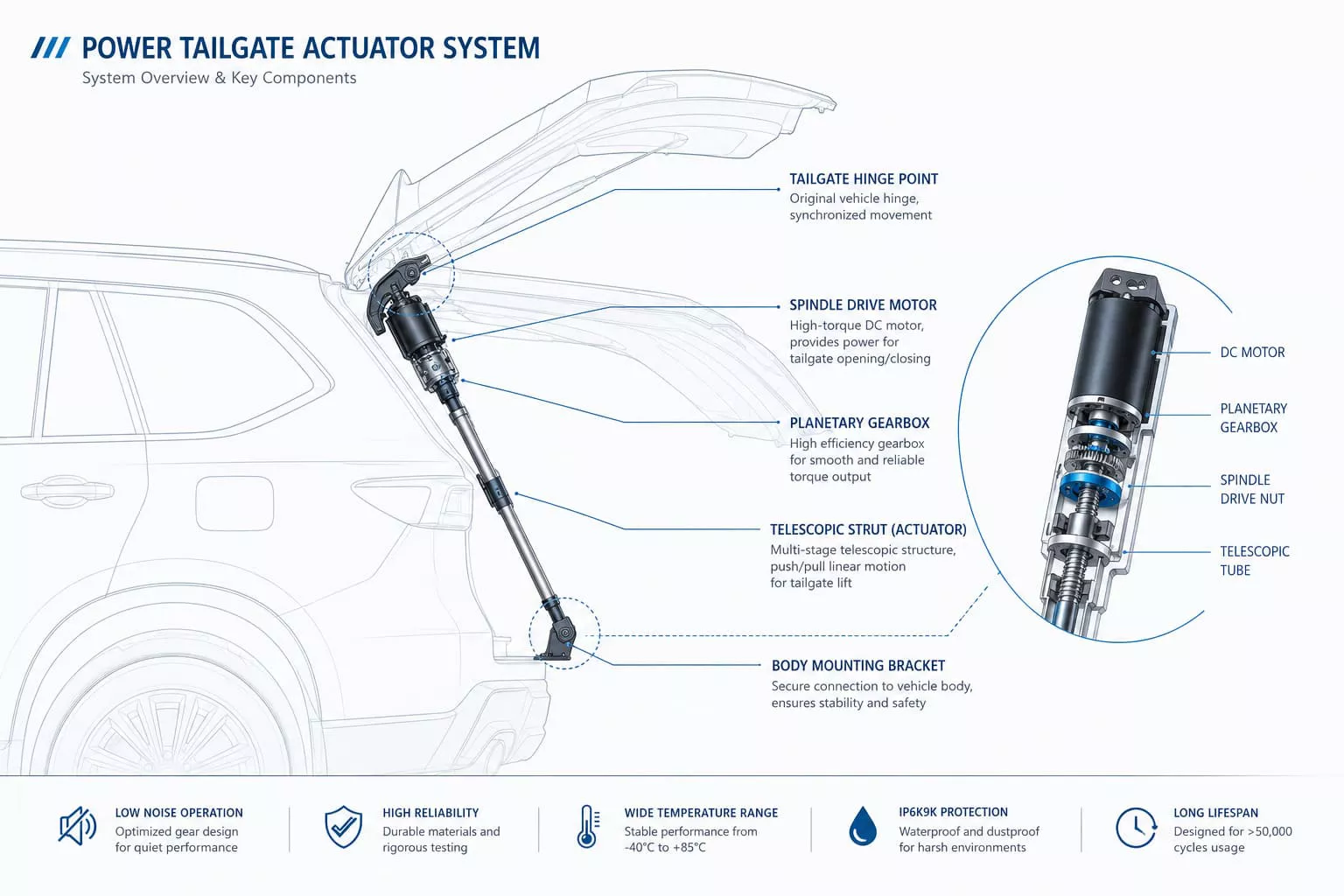
Fig. 1 — Automotive power tailgate structure diagram
The motor at the heart of an electric tailgate system does more than open and close a panel — it directly determines how much lifting force the actuator can deliver, how much noise reaches the cabin, how safely the system responds to an obstruction, and how long the whole assembly lasts before it needs warranty attention. Choosing the wrong power tailgate motor rarely shows up as an obvious failure on day one; it shows up months or years later, as a stall in cold weather, a whine that customers start commenting on, or a service bulletin.
Modern electric tailgate systems make this harder than it looks. The motor has to deliver enough starting torque to move a heavy panel from a dead stop, but stay compact enough to fit inside a slim actuator strut. It has to match the vehicle's electrical architecture — getting the automotive gear motor 12V 24V decision right is a basic prerequisite, not an afterthought. And it increasingly has to behave like a genuinely low noise car actuator motor, since cabin acoustic expectations have risen even on mainstream vehicle programs. This guide walks through the factors that actually decide whether a motor is right for a given tailgate program, and where planetary gear motor architecture fits into that decision.
2. Key Requirements for Automotive Tailgate Motors
| Requirement | Why It Matters |
| High torque | Heavy tailgate, long lever arm, worst-case seal drag at cold start |
| Low noise | Passenger comfort; gear whine reads as low quality |
| Compact size | Limited installation space inside the actuator strut |
| Long life | Frequent daily cycling over a 10+ year vehicle life |
| Low current draw | Protects battery and wiring harness sizing |
| IP protection | Outdoor, weather-facing mounting location |
| High efficiency | Energy saving and lower internal heat build-up |
High torque matters most at the very start of the opening stroke, when the tailgate is at its lowest point and the lever arm plus seal resistance work directly against the motor. Undersizing torque here causes stalling in cold weather or as seals stiffen with age. Low noise is now a brand differentiator: buyers compare tailgate operation sound between competing models. Compact size is dictated by the actuator strut, which typically has to fit within the same envelope as a manual gas-strut support. Long life is usually specified as a cycle count, validated through accelerated durability testing rather than extrapolated from bench data. Low current draw protects both the accessory battery and the wiring harness. IP protection prevents water ingress at the rear of the vehicle. High efficiency reduces energy waste and internal temperature rise, a major factor in long-term winding and bearing life.
3. Choosing Between 12V and 24V Automotive Gear Motors
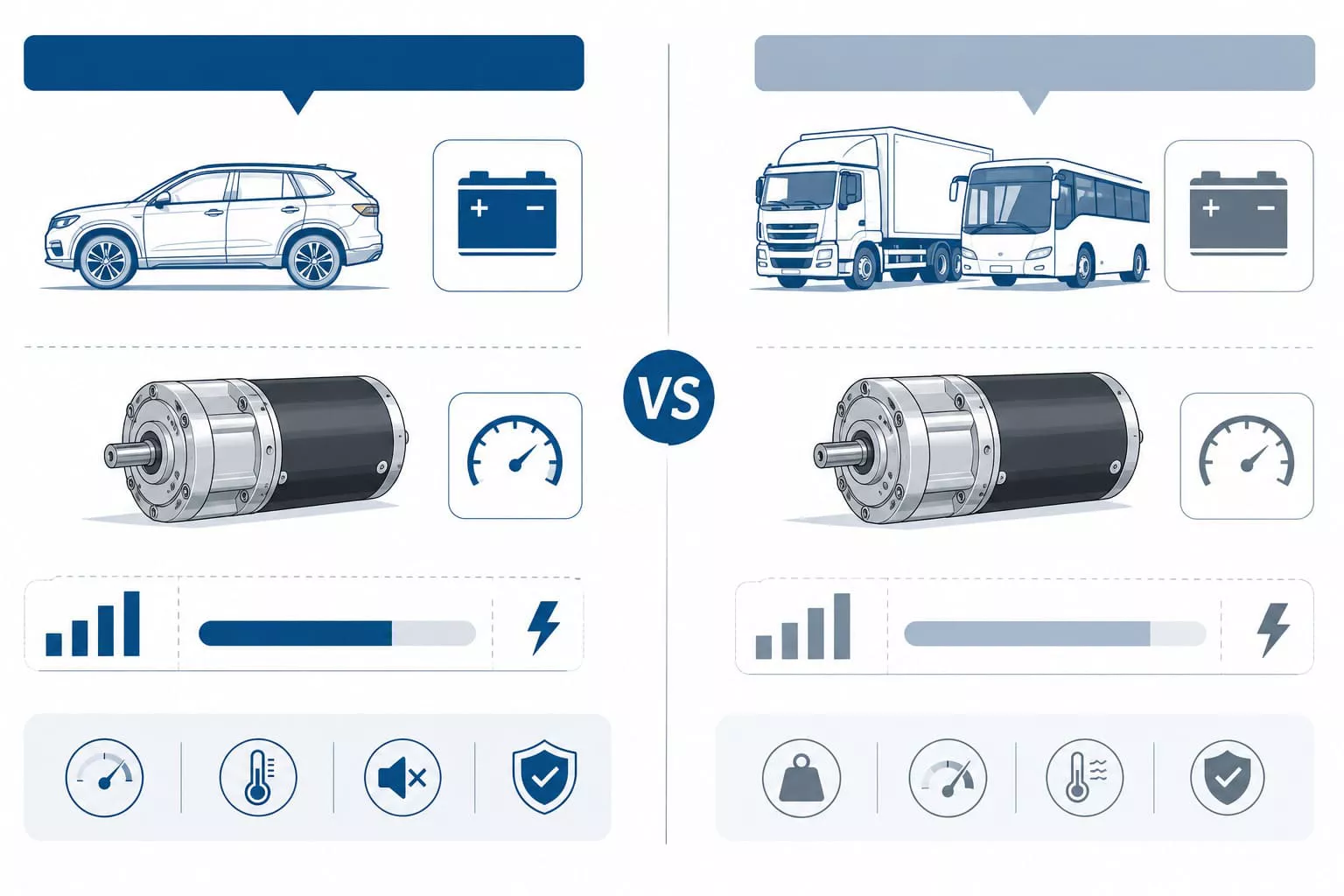
Fig. 2 — 12V vs 24V comparison chart
| Feature | 12V | 24V |
| Typical vehicle class | Passenger cars, SUVs, pickups | Commercial vehicles, trucks, electric buses |
| Current for equivalent power | Higher (roughly 2× for same wattage) | Lower |
| Wiring/harness sizing | Larger gauge needed | Thinner gauge possible |
| Component availability | Widest range, most cost-competitive | Narrower, often industrial-grade |
Most passenger cars and SUVs run a 12V architecture, so the large majority of power tailgate and liftgate motors are specified at 12V nominal, typically across a working range of roughly 9–16V to account for cranking and charging swings. Pickup trucks generally stay in the 12V family too, though torque requirements are usually higher given tailgate mass, addressed through gear ratio rather than voltage. Commercial vehicles and electric buses, which often run 24V architectures, specify 24V gear motors for consistency with the rest of the vehicle's actuators and to reduce current draw across longer wiring runs. The core trade-off: for the same output power, a 24V motor draws roughly half the current of a 12V motor. For a standard passenger vehicle, though, the automotive gear motor 12V 24V decision is effectively made by the vehicle's existing electrical platform, not chosen independently.
4. Gearbox Types for Power Tailgate Applications
| Gearbox | Efficiency | Noise | Backlash | Cost |
| Planetary | High | Low | Low | Medium |
| Spur | Medium-High | Medium | Medium | Low |
| Worm | Low-Medium | Low | Low | Low |
| Helical | High | Low | Low-Medium | Medium-High |
Planetary gearboxes distribute load across multiple planet gears meshing simultaneously with a central sun gear, spreading torque transmission across several contact points instead of one. This gives a compact diameter for a given torque output, along with naturally low backlash and quiet operation. Spur gearboxes are simple and inexpensive but transmit torque through straight-cut teeth that engage and disengage abruptly, producing more noise. Worm gearboxes offer self-locking output but carry an efficiency penalty from sliding friction. Helical gearboxes engage gradually for quieter operation and higher load capacity, usually at a larger footprint and higher cost. For these reasons, planetary gearboxes dominate modern automotive tailgate actuators.
5. Required Torque and Speed Calculation
Step 1 — Estimate load torque at the pivot: T_load = W × L × sin(θ), where W is tailgate weight (N), L is the effective lever arm (m), and θ is the tailgate angle, checked across the full travel range.
Step 2 — Add resistance margin: apply 30–50% over the static torque for seal drag, hinge friction, and worst-case wind loading.
Step 3 — Determine required output torque at the spindle/gearbox: load torque divided by linkage mechanical advantage, plus margin.
Step 4 — Select gear ratio: Gear Ratio = Motor Rated Torque × Gearbox Efficiency / Required Output Torque.
Step 5 — Check motor RPM: Motor RPM = Output Shaft RPM Needed × Gear Ratio.
Step 6 — Verify duty cycle against the motor's thermal time constant for repeated rapid cycling.
| Worked SUV example: A 180 N tailgate with a 0.5 m effective lever arm gives ~90 Nm at the hinge. A 40% margin brings the design target to ~126 Nm. With a 3:1 linkage advantage, the actuator needs ~42 Nm. A 0.4 Nm motor with a 120:1 planetary ratio at 85% gearbox efficiency delivers ~40.8 Nm — close to target, typically pushing designers toward the next standard ratio or a slightly higher-torque motor variant. |
This kind of calculation should always be validated against measured prototype data, since seal drag, temperature effects, and linkage friction are difficult to predict precisely from geometry alone.
6. Noise and Vibration Considerations
Achieving a genuinely low noise car actuator motor requires attention at every stage of the drivetrain: gear meshing precision reduces the micro-impacts that generate whine; bearing quality with correct preload reduces vibration transmitted into the housing; lubrication viscosity and quantity damps gear mesh noise; motor balancing prevents rotor imbalance from coupling into the housing; PWM control strategy minimizes audible current ripple; gear precision and tight backlash control removes clicking during direction changes; and housing rigidity prevents internal vibration from being amplified into audible noise.
Customer perception research in this space consistently shows tailgate noise is judged on character as much as loudness — a smooth, low-pitched hum reads as quality, while a higher-pitched whine or clicking reads as cheap, even at similar sound pressure levels. Noise engineering for this application therefore focuses as much on frequency content and consistency as on raw decibel reduction.
7. Importance of Encoder Feedback
Encoder feedback has moved from a premium feature to a near-standard requirement, because so much of a tailgate system's intelligence depends on knowing exactly where it is and how fast it's moving at every instant. Common types include incremental encoders (pulse trains proportional to shaft rotation), Hall-effect encoders (magnetic sensing, robust in automotive environments with contamination or vibration), magnetic encoders more broadly, and optical encoders (high resolution, less common here due to contamination sensitivity). Encoder data feeds directly into obstacle detection, soft start, soft stop, memory position, speed feedback, and synchronization between dual actuators on wider tailgates.
For engineers evaluating a motor platform with these requirements in mind, Toosyn's Small Precision Planetary Gear Motor Series provides a compact planetary gearbox architecture with optional encoder feedback integrated directly at the motor, simplifying mechanical integration for actuator designs that need position and speed data without adding a separate sensing module.
8. Brushed vs Brushless DC Gear Motors
| Factor | Brushed DC | Brushless DC |
| Maintenance | Brush wear over life | No brushes to wear |
| Efficiency | Lower | Higher |
| Price | Lower | Higher |
| Lifetime | Shorter (brush-limited) | Longer |
| Controller complexity | Simple direct DC drive | Requires commutation controller |
Brushed motors remain a cost-effective solution for tailgate applications with moderate cycle-life requirements and tight program cost targets, since they avoid the added cost of commutation electronics. Brushless motors are increasingly specified where cycle-life targets are high, EMI requirements are strict, or smoother torque output justifies the added electronics cost — a calculation that shifts as BLDC controller costs continue to fall.
9. Environmental Protection and Automotive Standards
Automotive tailgate motors operate in an exposed location, so environmental and quality standards are non-negotiable: IP54 as a common minimum against dust and splashing water; IP65 for exposed actuator sections; salt spray resistance (e.g., tested per ASTM B117); an operating temperature range typically spanning roughly -40°C to +85°C; humidity resistance; shock and vibration validation against automotive profiles; automotive EMC compliance; RoHS and REACH material restrictions; and quality system certifications including ISO 9001 and, for OEM-grade suppliers, IATF 16949. Buyers should verify these directly with a prospective supplier before sourcing.
10. Why Planetary Gear Motors Are Preferred
Planetary gear motors have become the default choice for automotive power tailgate actuators because of several compounding advantages: highest torque density among common gearbox architectures, low backlash supporting precise encoder-based control, long service life from load sharing across multiple planet gears, high efficiency, a compact form factor suited to cylindrical actuator housings, multiple reduction stages available from a common base motor, and low noise from smooth, distributed gear meshing.
Within this category, the Toosyn Small Precision Series is built around these same principles — an optional encoder, multiple available gear ratios, 12V and 24V options, a compact outer diameter suited to slim actuator housings, and a service life profile suited to the demands of automotive power tailgate systems.
11. Common Mistakes When Selecting Tailgate Motors
| Mistake 1 — Ignoring startup torqueSizing to average running torque instead of peak starting torque causes stalling in cold weather or with aged seals. Size to the worst-case starting condition, not the average cycle. |
| Mistake 2 — Ignoring duty cycleAssuming continuous-duty thermal ratings apply leads to premature winding failure under rapid repeated cycling. Validate against real-world cycles-per-hour, including edge cases. |
| Mistake 3 — Choosing the wrong voltageA voltage mismatch with the vehicle's architecture causes excess current draw and harness incompatibility. Confirm the vehicle's bus voltage before sourcing. |
| Mistake 4 — No encoderRelying solely on current sensing gives slower, less precise anti-pinch response and no memory-position capability. Specify encoder feedback for any soft-stop or memory-position requirement. |
| Mistake 5 — Ignoring temperature extremesValidating only at room temperature causes torque and speed drift, or lubricant stiffening, in cold climates. Test across the full automotive temperature range before finalizing the design. |
12. Recommended Small Precision Gear Motor Series
Toosyn is an active Tier 1 development partner for automotive power tailgate systems, working directly with vehicle manufacturers and actuator integrators on planet gear motor and actuator design. In a real production program referenced on our Car Power Tailgate application page, a 28mm planet gear motor with a dual-channel Hall sensor was engineered to deliver 750N pushing force and 500N drawing force from a DC permanent magnet motor, while meeting low-noise and variable-opening-angle requirements across different vehicle geometries.
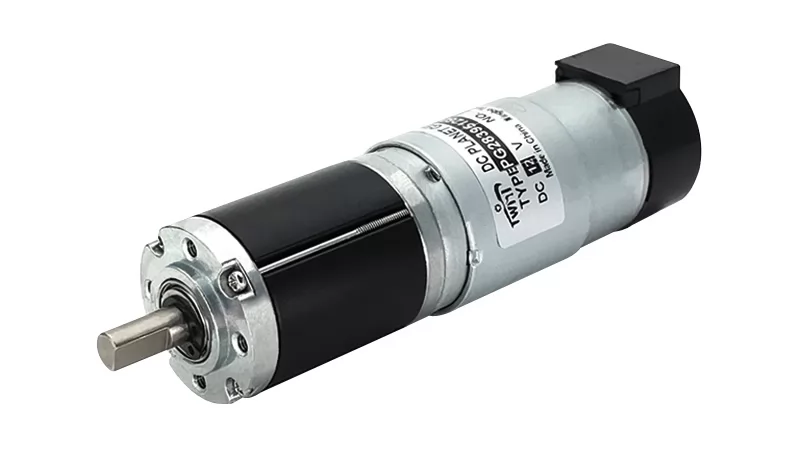 |
PG28395 Series — 28mm Planetary Gear Motor with Encoder (3–11W)
12V / 24V | RS-395 brushed motor + planetary gearbox + encoder | Rated torque 10–50 kg.cm | Compact diameter matching typical actuator strut envelopes
View PG28395 series specifications → |
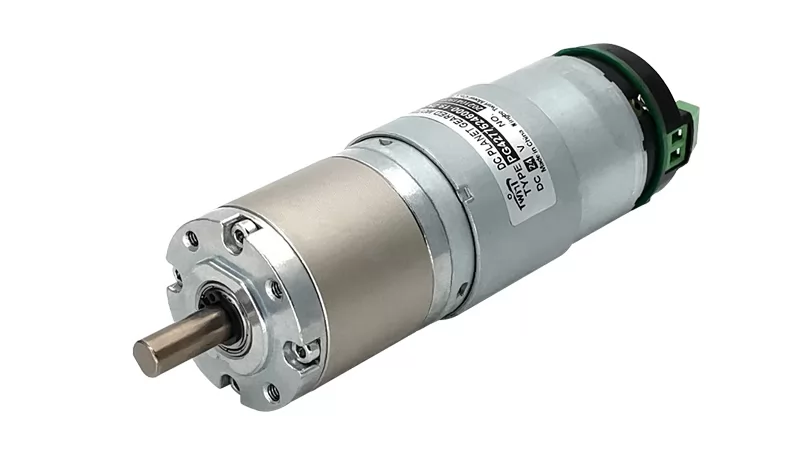 |
PG42775 Series — 42mm Planetary DC Gear Motor with Encoder (10–30W)
12V / 24V | Planetary gearbox + integrated encoder | Rated torque 50–200 kg.cm | For heavier tailgates or wider opening-force margins than the 28mm frame supports
View PG42775 series specifications → |
Both series share the same underlying platform advantages: a planetary gearbox for high torque density and low backlash, a dual-channel Hall encoder option for anti-pinch and soft-stop control, and full customization of gear ratio, shaft interface, and wiring to match an existing actuator design. Frame size is selected based on your target pushing/drawing force and available installation diameter — the 28mm frame covers most passenger-vehicle tailgate programs, while the 42mm frame provides margin for heavier tailgates or wider vehicles. Our engineering team can recommend the right series and gear ratio from your torque calculation and actuator envelope.
13. Frequently Asked Questions
Should I choose 12V or 24V?
This is usually set by your vehicle's electrical system, not chosen separately. Passenger cars, SUVs, and pickups run 12V; commercial vehicles and buses often run 24V. Tell us your platform and we'll confirm the right voltage.
Do you offer motors with an encoder?
Yes. Our PG28395 and PG42775 series both offer an optional integrated encoder for position feedback, anti-pinch detection, and soft-stop control — standard for intelligent tailgate systems.
Can the motor be customized for our actuator design?
Yes. Gear ratio, shaft type, wiring, connectors, and sealing can all be customized to fit an existing actuator or a new development program.
What torque and frame size do we need?
It depends on your tailgate weight and lever arm. As a starting point, our 28mm series covers most passenger vehicle tailgates; 42mm suits heavier tailgates or larger vehicles. Send us your target force and we'll recommend a series.
Are your motors automotive-certified?
Yes. Toosyn is IATF 16949 certified, with environmental testing covering temperature, humidity, and vibration for automotive-grade applications.
What do you need from us to start a quote?
Target torque or force, voltage, duty cycle, and available installation space. With these, our engineering team can recommend a suitable series and gear ratio before quoting.
14. Conclusion
Selecting the right DC gear motor for an automotive power tailgate comes down to a consistent set of criteria: matching voltage to the vehicle's electrical architecture, sizing torque and gear ratio to the actual mechanical load with appropriate margin, choosing a gearbox type that balances torque density against noise and backlash, adding encoder feedback where soft-stop, memory-position, or precise obstacle detection are required, engineering for low noise from the earliest design stage, and verifying environmental protection and automotive quality certifications before sourcing.
Across all of these criteria, planetary DC gear motors have become the standard choice in modern intelligent liftgate systems, largely because their compact size and high torque density let them satisfy tight actuator packaging constraints while still meeting the noise, precision, and durability expectations of today's vehicle programs. Engineers working through this selection process for a specific tailgate design can review detailed specifications and engineering support for the Small Precision Planetary Gear Motor Series to evaluate fit against their own torque and packaging requirements.
|
Need help specifying torque, gear ratio, and encoder configuration for a power tailgate program? Send us your application requirements and our engineers will recommend a suitable motor configuration.
|
0
Comments
Leave a Comment
Your email address will not be published. Required fields are marked *
Name can't be empty
Email error!
Message can't be empty
😍
😜
😳
😌
😄
😘
😝
😒
😃
😚
😚
😛
😟
😧
😀
😉
😓
😱
😤
😣
😂
😥
😩
😠
😢
😭
😰
😨
😡
😆
😪
😅
😐
😇
😋
😴
👿
😕
😏
😷
😵
😟
😮
😯
😑
👧
👴
😧
😬
😾
👶
👱
👵
👸
🙀
👺
👦
👩
👨
😽
😿
🙈
💩
💥
💤
😼
😹
🙉
🔥
✨
💦
👎
✌
👆
👈
💪
💹
👍
👊
💴
💶
💷
💸
👉
💵
🙏
🌎
🏧
👏
💳
👇
💑
🙆
🙅
💁
👫
👭
🙎
🙇
👑
👔
Submit Comment
Most Popular
-
 Aug 21, 2025Which Motor Is Best for Electric Vehicle? A Complete Guide for 2026
 -
 Oct 16, 2025Top 10 DC Motor Manufacturers in China 2026
 -
 Dec 18, 2025The Ultimate Buyer's Guide to High Torque DC Motors
 -
 Apr 11, 2026Top 10 China Gear Motor Manufacturer in 2026


Laster Blogs
-
 Aug 20, 2026Why Planetary Gear Motors Offer Low Backlash for Precision Positioning
 -
 Aug 19, 2026Planetary Gear Ratio Calculation: How to Calculate the Right Gear Ratio for Your Motor
 -
 Aug 18, 2026Planetary Gearbox vs Spur Gearbox: Why Planetary Wins in Compact High-Torque Applications
 -
 Aug 17, 2026What Is a Planetary DC Gear Motor and How Does It Work?


Set A Consultation Today
Name can't be empty
Email error!
Send Your Message
*We respect your confidentiality and all
information are protected.


